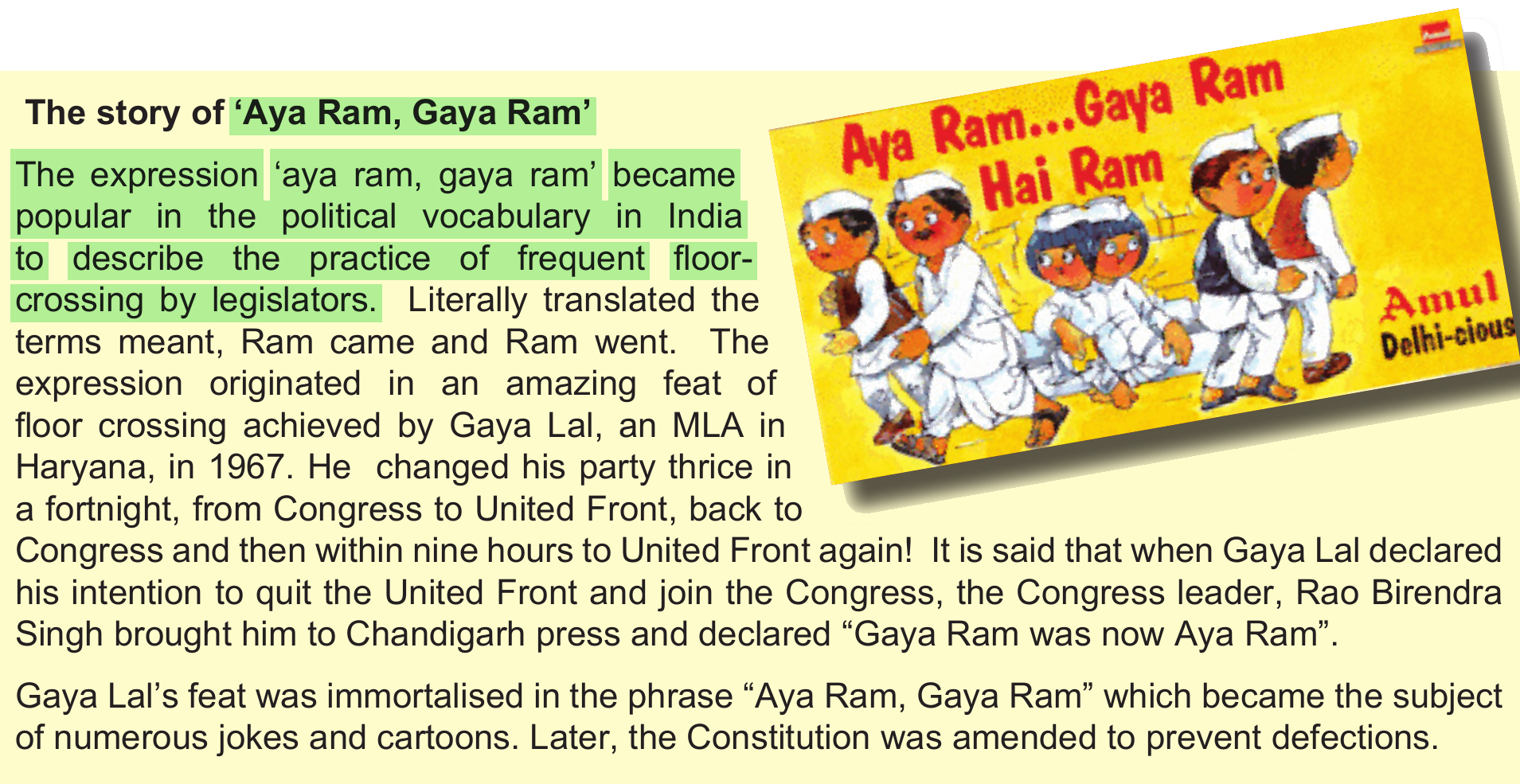
Match List-I with List-II
| List-I | List-II |
| (A) Aya Ram, Gaya Ram | (I) Floor-Crossing |
| (B) Political earthquake | (II) Fourth general election |
| (C) Non-Congressism | (III) Anti-congress parties’ strategy against Congress |
| (D) Save Democracy | (IV) Opposition slogan during 1977 election |
Choose the correct answer from the options given below:
Answer & explanation
Correct answer: option 1
The correct answer is Option (1) → (A)-(I), (B)-(II), (C)-(III), (D)-(IV)
(A) Aya Ram, Gaya Ram — this matches (I) Floor-Crossing. The expression describes the practice of frequent floor-crossing by legislators.
(B) Political earthquake — this matches (II) Fourth general election. Observers described the results of the 1967 elections as a ‘political earthquake’.
(C) Non-Congressism — this matches (III) Anti-congress parties’ strategy against Congress. Ram Manohar Lohia gave this name to the strategy of non-Congress parties coming together against the Congress.
(D) Save Democracy — this matches (IV) Opposition slogan during 1977 election. The opposition fought the 1977 election on the slogan of ‘save democracy’.
NCERT (2026-27): “Electoral verdict … The Congress was facing the electorate for the first time without Nehru. The results jolted the Congress at both the national and state levels. Many contemporary political observers described the election results as a ‘political earthquake’. The Congress did manage to get a majority in the Lok Sabha, but with its lowest tally of seats and share of votes since 1952.… Non-Congressism … Parties opposed to the Congress realised that the division of their votes kept the Congress in power. Thus parties that were entirely different and disparate in their programmes and ideology got together to form anti-Congress fronts in some states and entered into electoral adjustments of sharing seats in others. They felt that the inexperience of Indira Gandhi and the internal factionalism within the Congress provided them an opportunity to topple the Congress. The socialist leader Ram Manohar Lohia gave this strategy the name of ‘non-Congressism’. He also produced a theoretical argument in its defence: Congress rule was undemocratic and opposed to the interests of ordinary poor people; therefore, the coming together of the non-Congress parties was necessary for reclaiming democracy for the people.” NCERT (2026-27), chapter ‘The Crisis of Democratic Order’: “Politics after Emergency The most valuable and lasting lesson of the Emergency was learnt as soon as the Emergency was over and the Lok Sabha elections were announced. The 1977 elections turned into a referendum on the experience of the Emergency, at least in north India where the impact of the Emergency was felt most strongly. The opposition fought the election on the slogan of ‘save democracy’. The people’s verdict was decisively against the Emergency.…”
|