
Match List-I with List-II.
| List-I | List-II |
|---|---|
| A. Multicarpellary | I. A single pistil |
| B. Syncarpous | II. Free pistils |
| C. Apocarpous | III. Fused pistils |
| D. Monocarpellary | IV. More than one pistil |
Choose the correct answer from the options given below:
Answer & explanation
Correct answer: option 3
The correct answer is Option (3) → A-IV, B-III, C-II, D-I
The gynoecium may have one pistil or more. When there is more than one, the pistils may be fused together or free from each other.
(A) Multicarpellary — this matches (IV) More than one pistil. The prefix multi- shows that the gynoecium has several pistils.
(B) Syncarpous — this matches (III) Fused pistils. The pistils are fused together, as in Papaver.
(C) Apocarpous — this matches (II) Free pistils. The pistils stay separate, as in Michelia.
(D) Monocarpellary — this matches (I) A single pistil.
So the correct match is A-IV, B-III, C-II, D-I.
NCERT Extract:
The Pistil, Megasporangium (Ovule) and Embryo Sac – “The gynoecium represents the female reproductive part of the flower. The gynoecium may consist of a single pistil (monocarpellary) or may have more than one pistil (multicarpellary). When there are more than one, the pistils may be fused together (syncarpous) (Figure 1.7b) or may be free (apocarpous) (Figure 1.7c).”
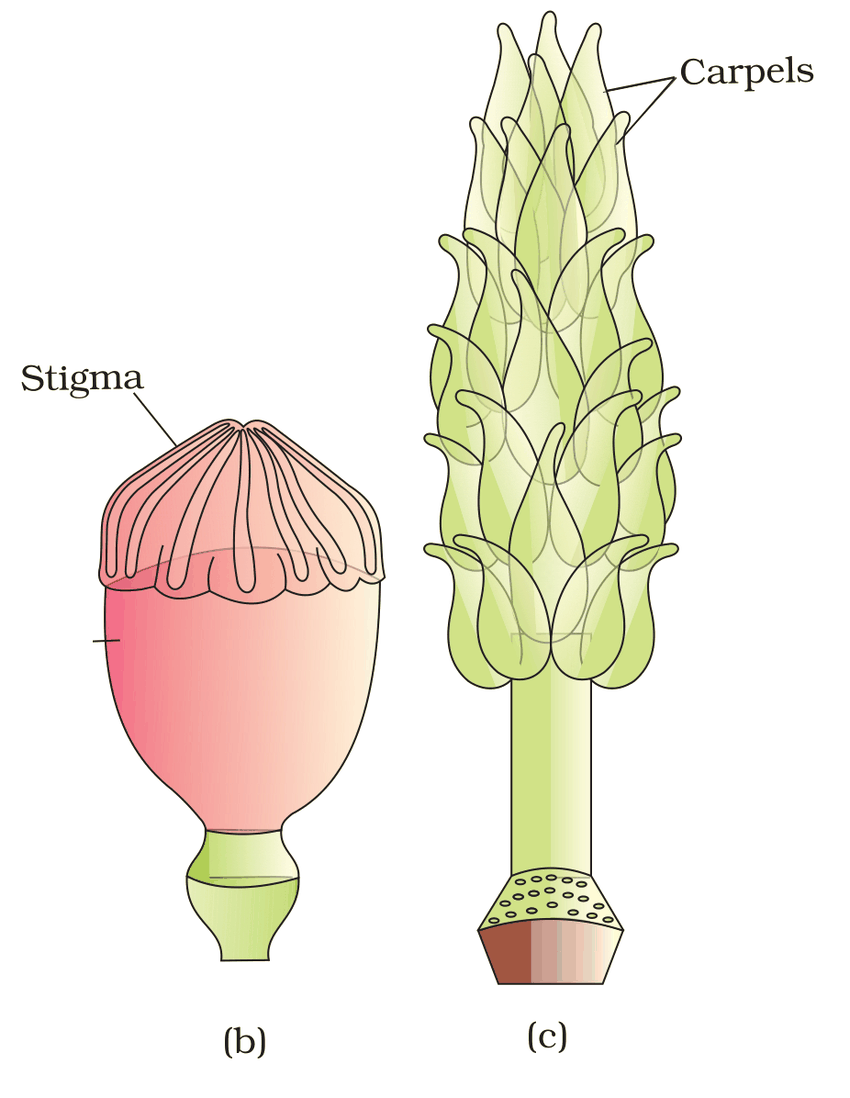
Figure 1.7 (b) Multicarpellary, syncarpous pistil of Papaver; (c) A multicarpellary, apocarpous gynoecium of Michelia