
For an LCR circuit:
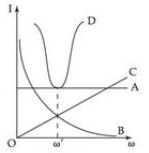
(i) C and D represent R and Z, respectively.
(ii) A, B, C, D represent \( R, X_C, X_L \) and Z, respectively.
(iii) C and D represent Z and R, respectively.
(iv) A and B represent R and \( X_L \), respectively.
(v) For \( \omega = \omega' \), the phase difference between current and voltage is zero.
(\( R, Z, X_C, X_L, \omega, \omega' \) have their usual meaning)
Choose the correct answer from the options given below:
Answer & explanation
Correct answer: option 3
The correct answer is Option (3) → (ii), (v) only
Identify the four curves from how each quantity varies with the angular frequency \( \omega \) of the source.
\( R \): independent of \( \omega \), a horizontal line, so A
\( X_C = 1/\omega C \): falls as \( \omega \) rises, so B
\( X_L = \omega L \): a straight line rising from the origin, so C
\( Z = \sqrt{R^{2} + (X_L - X_C)^{2}} \): has a minimum, so D
(i) C and D represent R and Z, respectively — Incorrect. C is \( X_L \), not R.
(ii) A, B, C, D represent \( R, X_C, X_L \) and Z, respectively — Correct. This is the identification made above.
(iii) C and D represent Z and R, respectively — Incorrect. C is \( X_L \) and D is Z.
(iv) A and B represent R and \( X_L \), respectively — Incorrect. B falls as \( \omega \) rises, so it is \( X_C \), not \( X_L \).
(v) For \( \omega = \omega' \), the phase difference between current and voltage is zero — Correct. At \( \omega' \) the curves of \( X_L \) and \( X_C \) cross, so \( X_L = X_C \) and \( Z = R \) is at its minimum (curve D touches A). This is resonance: \( \tan\phi = (X_L - X_C)/R = 0 \), so current and voltage are in phase.