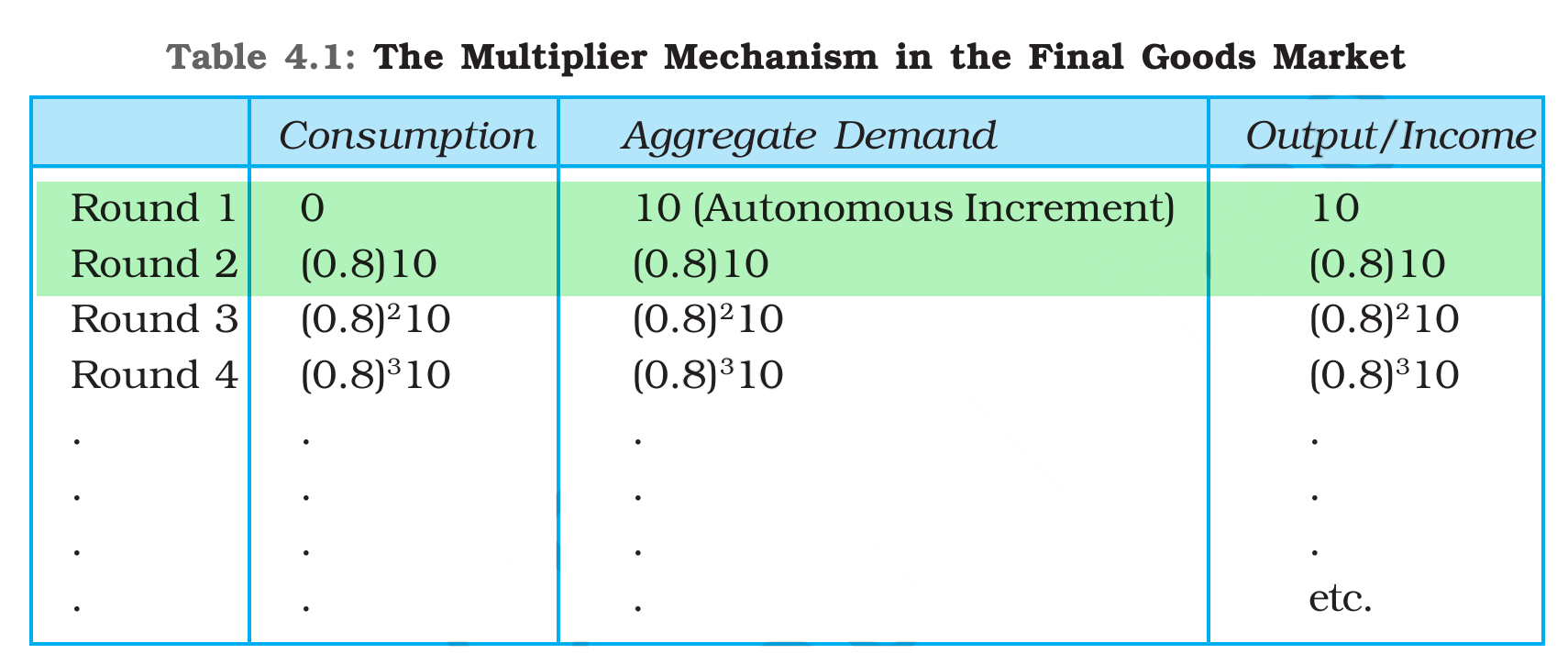
Consider the following statements about NCERT’s round-by-round table of the multiplier mechanism in the final goods market, where autonomous expenditure rises by 10 and the mpc is 0.8:
(A) From Round 2 onwards, the increments in consumption, aggregate demand and output are equal in each round.
(B) The increment in output in Round 2 is (0.2)10.
(C) In Round 1, the increment in aggregate demand is the autonomous increment of 10.
(D) In Round 1, the increment in consumption is zero.
(E) The last column of the table measures the increments in saving in each round.
Which of the statements given above are correct?
Choose the correct answer from the options given below:
Answer & explanation
Correct answer: option 3
The correct answer is Option (3) → (A), (C) and (D) only
(A) From Round 2 onwards, the increments in consumption, aggregate demand and output are equal in each round. — Correct. From Round 2, each column shows (0.8)10, (0.8)210 and so on.
(B) The increment in output in Round 2 is (0.2)10. — Incorrect. The Round 2 increment is (0.8)10: people spend the MPC share of the extra income, not the MPS share.
(C) In Round 1, the increment in aggregate demand is the autonomous increment of 10. — Correct. Round 1 is the autonomous increment of 10.
(D) In Round 1, the increment in consumption is zero. — Correct. In Round 1 no extra income has yet been earned, so consumption has not changed.
(E) The last column of the table measures the increments in saving in each round. — Incorrect. The last column measures increments in output (income), not saving.
NCERT (2026-27): “4.3.3 The Multiplier Mechanism … Let us register the changes in the values of aggregate demand and output at each round in Table 4.1. The last column measures the increments in the value of the output of final goods (and hence the income of the economy) in each round. The second and third columns measure the increments in total consumption expenditure in the economy and increments in the value of aggregate demand in a similar way.”
|