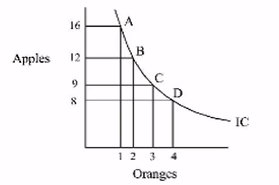
According to an indifference curve, going from point B to C, what is the position of MRS ?
Answer & explanation
Correct answer: option 2
The correct answer is Option (2) → 3 : 1
Given (read from the curve):
At point B: 2 oranges and 12 apples
At point C: 3 oranges and 9 apples
The marginal rate of substitution (MRS) is the amount of apples the consumer gives up for one more orange, her utility staying the same:
Apples given up = 12 − 9 = 3
Oranges gained = 3 − 2 = 1
MRS = 3 : 1
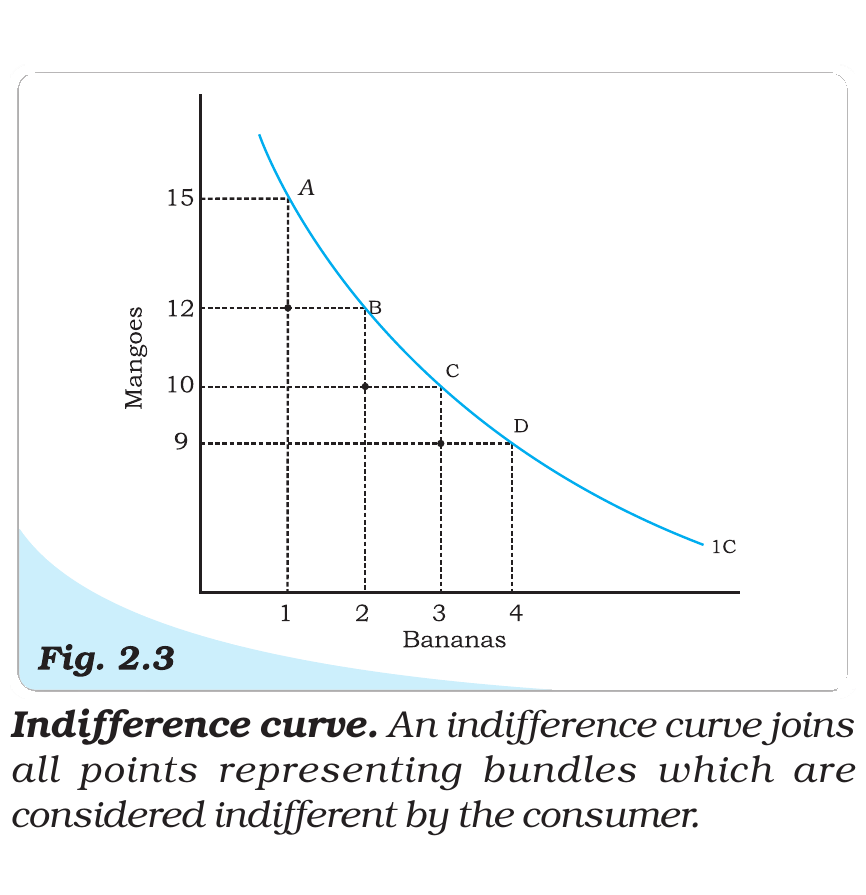
NCERT (2026-27): “2.1.2 Ordinal Utility Analysis … It is clear that when a consumer gets one more banana, he has to forego some mangoes, so that her total utility level remains the same and she remains on the same indifference curve. Therefore, indifference curve slopes downward. The amount of mangoes that the consumer has to forego, in order to get an additional banana, her total utility level being the same, is called marginal rate of substitution (MRS).… …This can be seen from figure 2.3 also. Going from point A to point B, the consumer sacrifices 3 mangoes for 1 banana, going from point B to point C, the consumer sacrifices 2 mangoes for 1 banana, and going from point C to point D, the consumer sacrifices just 1 mango for 1 banana. Thus, it is clear that the consumer sacrifices smaller and smaller quantities of mangoes for each additional banana.”
|