Match List-I with List-II
| List-I (Issues related to India’s Foreign Policy) | List-II (Year) | ||
| (A) | Dalai Lama crossed over to Indian border and sought asylum | (I) | 1976 |
| (B) | China’s invasion of India | (II) | 1962 |
| (C) | Restoration of full diplomatic relations between India and China | (III) | 1959 |
| (D) | Panchsheel agreement signed | (IV) | 1954 |
Choose the correct answer from the options given below:
Answer & explanation
Correct answer: option 2
The correct answer is Option (2) → (A) – (III), (B) – (II), (C) – (I), (D) – (IV)
(A) Dalai Lama crossed over to Indian border and sought asylum — this matches (III) 1959. It came after the armed uprising in Tibet of 1958 was suppressed.
(B) China’s invasion of India — this matches (II) 1962.
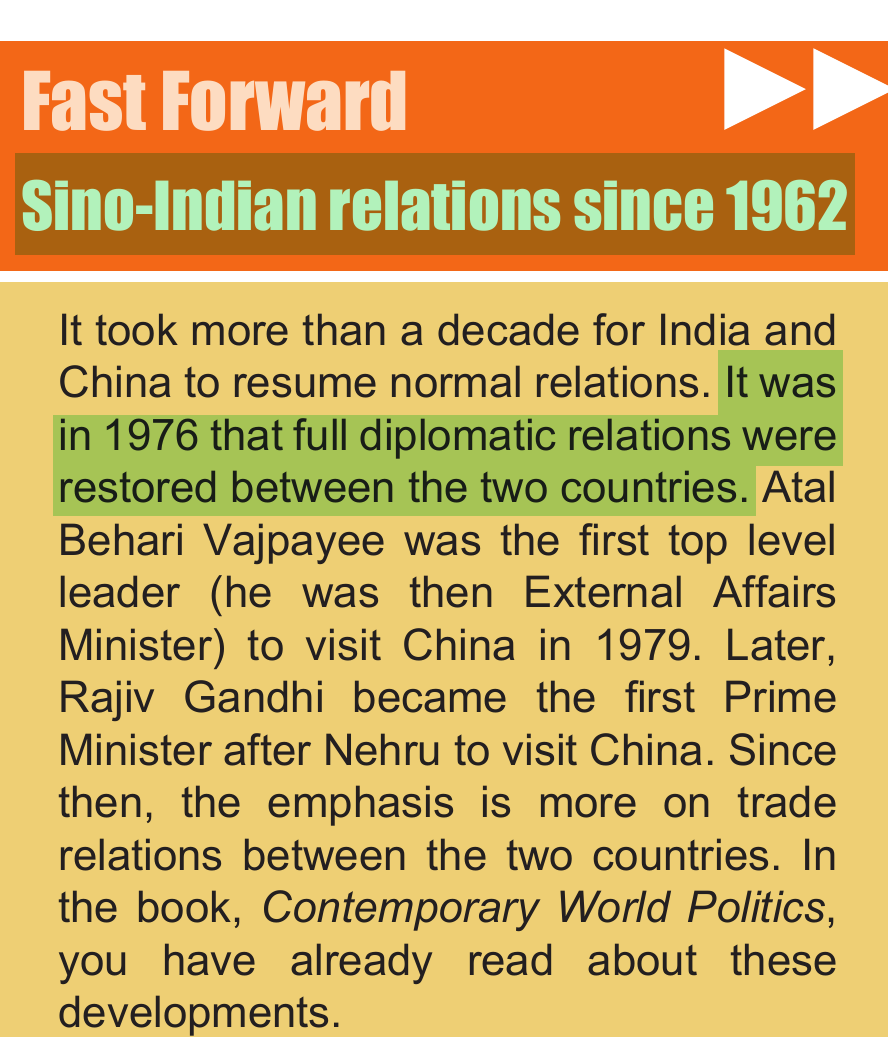
(C) Restoration of full diplomatic relations between India and China — this matches (I) 1976.
(D) Panchsheel agreement signed — this matches (IV) 1954.
NCERT (2025-26): “Peace and conflict with China … When the Panchsheel agreement was signed between India and China in 1954, through one of its clauses about respecting each other’s territorial integrity and sovereignty, India conceded China’s claim over Tibet. The Tibetan spiritual leader Dalai Lama accompanied the Chinese Premier Zhou Enlai during the official Chinese visit to India in 1956. He informed Nehru about the worsening situation in Tibet. But China had already assured India that Tibet will be given greater autonomy than enjoyed by any other region of China. In 1958, there was armed uprising in Tibet against China’s occupation. This was suppressed by the Chinese forces. Sensing that the situation had become worse, in 1959, the Dalai Lama crossed over into the Indian border and sought asylum which was granted.… The Chinese invasion, 1962 … Around this time, while the entire world’s attention was on the Cuban Missile crisis involving the two superpowers, China launched a swift and massive invasion in October 1962 on both the disputed regions.…”
|