Arrange the following statements in chronological order in respect to the increase in the proportion of income people save.
(A) Marginal propensity to consume decreases.
(B) The level of income decreases.
(C) The amount of savings remains the same.
(D) The aggregate demand curve shifts downwards.
Choose the correct answer from the options given below:
Answer & explanation
Correct answer: option 4
The correct answer is Option (4) → (A), (D), (B), (C)
When all the people save a larger part of their income, total saving still does not rise. This is the Paradox of Thrift, and it comes about in these steps.
(A) Marginal propensity to consume decreases. — People save a larger part of each extra rupee, so they spend a smaller part. So the marginal propensity to consume (MPC) falls.
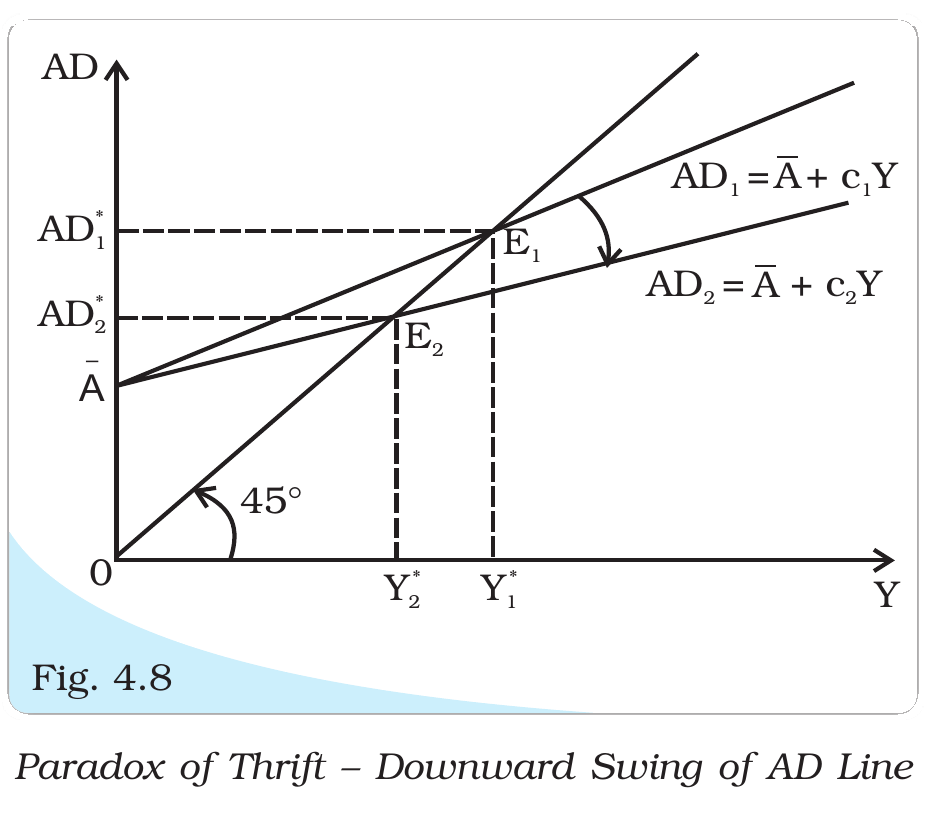
(D) The aggregate demand curve shifts downwards. — The MPC is the slope of the aggregate demand (AD) line. A lower MPC reduces this slope, so the AD line swings downwards.
(B) The level of income decreases. — Demand is now lower, so firms produce less. The lower income cuts spending again, round after round (the multiplier), so equilibrium income falls.
(C) The amount of savings remains the same. — In equilibrium, saving equals planned investment, and investment here does not depend on income. So total saving ends up where it was.
Note: A same/similar question was asked in CUET (UG) in the papers below.
| 2026 | 2025 | 2024 | 2023 | 2022 |
| – | 31-05 S1 02-06 S1 | – | – | – |
NCERT (2026-27): “Paradox of Thrift If all the people of the economy increase the proportion of income they save (i.e. if the mps of the economy increases) the total value of savings in the economy will not increase – it will either decline or remain unchanged.… …Suppose at the initial equilibrium of Y = 250, there is an exogenous or autonomous shift in peoples’ expenditure pattern – they suddenly become more thrifty.…Hence the mps of the economy increases, or, alternatively, the mpc decreases from 0.8 to 0.5.… …But that would mean a reduction in factor payments in the next round and hence a reduction in income by 75.… …Total value of savings in the economy has, therefore, remained unchanged. When A̅ changes the line shifts upwards or downwards in parallel. When c changes, however, the line swings up or down. An increase in mps, or a decline in mpc, reduces the slope of the AD line and it swings downwards. We depict the situation in Fig. 4.8.… …The equilibrium output and aggregate demand have declined by 150. As explained above, this, in turn, implies that there is no change in the total value of savings.”
|