Which of the following compound will undergo Cannizzaro reaction?
Answer & explanation
Correct answer: option 1
The correct answer is Option (1) → Methanal
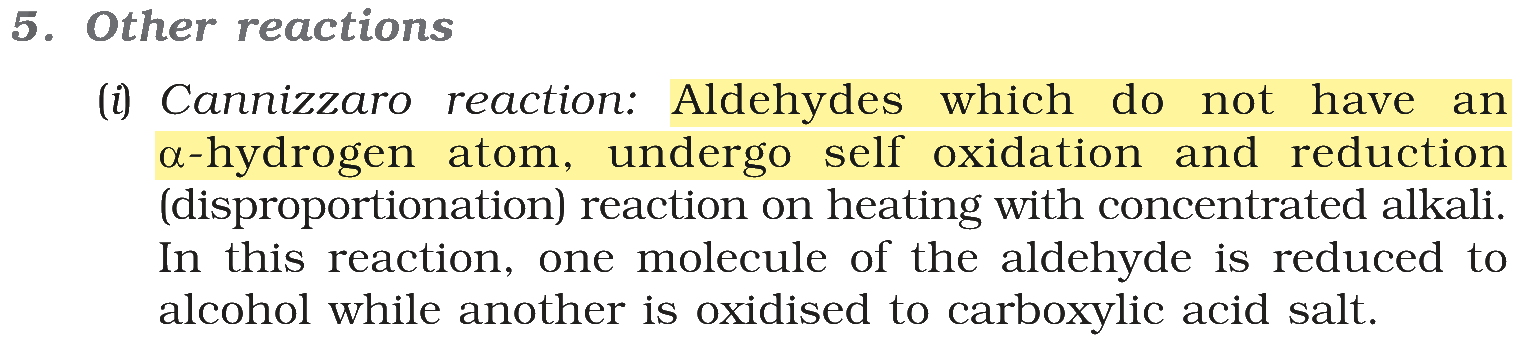
Aldehydes and ketones that have an α-hydrogen undergo aldol reactions with dilute alkali, because the base removes that hydrogen. Aldehydes with no α-hydrogen cannot do this; with concentrated alkali they undergo the Cannizzaro reaction instead.
Methanal, HCHO, has no carbon next to the carbonyl group and so no α-hydrogen:
\( \displaystyle \ce{2HCHO} \xrightarrow[\Delta]{\text{conc. }\ce{KOH}} \ce{CH3OH + HCOOK} \)
So methanal undergoes the Cannizzaro reaction.
Why the other options are incorrect
Option (2) Cyclohexanone — Incorrect. It is a ketone with four α-hydrogens; ketones do not show the Cannizzaro reaction, and cyclohexanone gives aldol condensation instead.
Option (3) Propanal — Incorrect. \( \ce{CH3CH2CHO} \) has two α-hydrogens, so with alkali it gives an aldol: \( \ce{2CH3CH2CHO} \xrightarrow{\text{dil. }\ce{NaOH}} \ce{CH3CH2CH(OH)CH(CH3)CHO} \).
Option (4) Acetone — Incorrect. A methyl ketone with six α-hydrogens; it undergoes aldol condensation, not the Cannizzaro reaction.
NCERT (2026-27 edition):
Other Reactions