
CUETMOCK
  • Pricing
  • Mentors
Log inStart freeStart free mocks→

First test, then trust

Try a free CUET mock test.

Join 5,00,000+ students who rehearsed exam day on the exact NTA screen before sitting CUET. On the web and on Android.

Start free mocks →Get the Android app
CUETMOCK

India's #1 CUET Mock Test Platform. Original NCERT-based questions on the exact NTA exam screen — trusted by 5,00,000+ students since CUET 2022.

Get it onGoogle PlayScan to download the CUETMOCK app

Mock tests

  • CUET mock test series
  • Commerce mocks
  • Humanities (Arts) mocks
  • Science mocks
  • Languages & GAT mocks
  • Free practice questions
  • Pricing

Resources

  • CUET exam guide
  • CUET syllabus
  • Universities accepting CUET
  • Expert blogs
  • News & notifications
  • Webinars & counselling
  • CUET score calculator
  • How we estimate your rank
  • FAQs

Company

  • About us
  • Our leadership & team
  • Our toppers
  • Mentors
  • For schools
  • Contact us
  • Terms
  • Privacy
  • Refund policy

Talk to us

+91 7696 6630 56info@cuetmock.comWhatsApp us

Our other platforms

  • JEE Mock — For IIT-JEE aspirants
  • NEET Mock — For NEET aspirants

Newsletter

Exam updates, study material and offers — no spam.

© 2026 NYC Ventures Pvt. Ltd.

701-702, Royal Business Park, Zirakpur, Punjab - 140603

  • Terms of use
  • Privacy policy
  • Refund policy
  • Contact us

iCUETMOCK is an independent preparation platform, not affiliated with the National Testing Agency (NTA). Always check exam details on the official NTA website.

  • Home
  • Mock tests
  • CUET guide
  • Pricing
  • Log in
Home/Practice questions/Biology
BiologySexual Reproduction in Flowering Plants

Arrange the following in the correct developmental sequence:A. Micros…

Read the passage and answer the following questions:

A typical angiosperm anther is bilobed with each lobe having two theca, i.e., they are dithecous. The anther is a four-sided (tetragonal) structure consisting of four microsporangia located at the corners, two in each lobe. The microsporangia develop further and become pollen sacs. They extend longitudinally all through the length of an anther and are packed with pollen grains. In a transverse section, a typical microsporangium appears near circular in outline. It is generally surrounded by four wall layers. When the anther is young, a group of compactly arranged homogenous cells called the sporogenous tissue occupies the centre of each microsporangium. As the anther develops, the cells of the sporogenous tissue undergo meiotic divisions to form microspore tetrads. As the anthers mature and dehydrate, the microspores dissociate from each other and develop into pollen grains. Inside each microsporangium several thousands of microspores or pollen grains are formed that are released with the dehiscence of anther.

Arrange the following in the correct developmental sequence:

A. Microspore tetrad

B. Male gametes

C. Pollen mother cell

D. Pollen grain

Choose the correct answer from the options given below:

Answer & explanation+

Correct answer: option 3

The correct answer is Option (3) → C, A, D, B

The passage states that the cells of the sporogenous tissue undergo meiosis to form microspore tetrads, and that the microspores then separate and develop into pollen grains. The male gametes are formed later, inside the pollen grain.

C. Pollen mother cell — First. Each cell of the sporogenous tissue is a potential pollen mother cell (PMC). It divides by meiosis.

A. Microspore tetrad — Second. The four microspores formed from one PMC stay together as a cluster called the microspore tetrad.

D. Pollen grain — Third. As the anther matures and dries, the microspores separate and each develops into a pollen grain with a vegetative cell and a generative cell.

B. Male gametes — Fourth. The generative cell of the pollen grain divides by mitosis to give two male gametes, either before shedding or in the pollen tube.

NCERT Extract:
Microsporogenesis – “… As each cell of the sporogenous tissue is capable of giving rise to a microspore tetrad. Each one is a potential pollen or microspore mother cell. The process of formation of microspores from a pollen mother cell (PMC) through meiosis is called microsporogenesis. The microspores, as they are formed, are arranged in a cluster of four cells–the microspore tetrad (Figure 1.3a). As the anthers mature and dehydrate, the microspores dissociate from each other and develop into pollen grains (Figure 1.3 b).”
Pollen grain – “… In the remaining species, the generative cell divides mitotically to give rise to the two male gametes before pollen grains are shed (3-celled stage).”
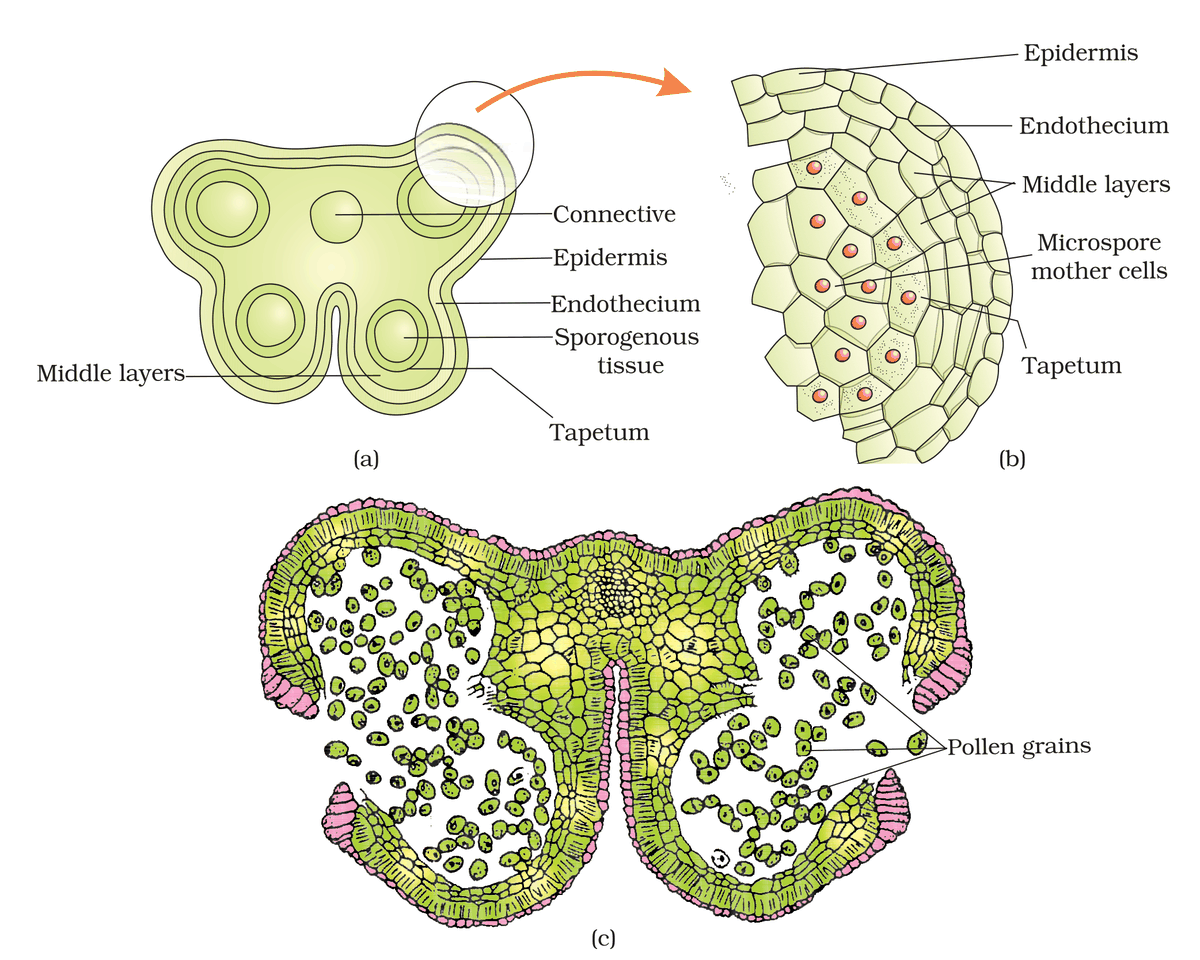
Textbook figure

Figure 1.3 (a) Transverse section of a young anther; (b) Enlarged view of one microsporangium showing wall layers; (c) A mature dehisced anther

Advertisement

Practise more on Sexual Reproduction in Flowering Plants

Chapter-wise mocks on the real NTA exam screen, with solutions and your rank. Your first mocks are free.

Start free mocks →

Advertisement

Next questions

  1. Find: ∫ (2x + 1)/((x + 1)^2(x - 1)) dxMaths. Section B1 · Indefinite Integration
  2. Three vectors a, b and c satisfy the condition a + b + c = 0. Evaluate the quantity μ = a·b + b·c + c·a, if |a| = 3, |b| = 4 and |c| = 2.Maths. Section B1 · Vectors
  3. Choose the correct meaning of the underlined idiom. Everyone laughed, because they knew that Arjun’s praise of the canteen food was tongue…English · Grammar: Idioms
  4. Select the option in which the numbers are related in the same way as are the numbers in the given set. (7, 49, 343)General Aptitude Test · General Ability
  5. For x ∈ R - 0 , the function f(x) =displaystyle3/x+ 7 is decreasing whenMaths. Section B1 · Applications of Derivatives
  6. When you find others also favoring capital punishment, you feel that your favorable view on capital punishment is validated by the public.…Psychology · Social Influence and Group Processes
  7. Which two signs need to be interchanged to make the following equation correct? 3 × 10 + 3 − 21 ÷ 3 = 34General Aptitude Test · Verbal Reasoning
  8. In 1877 who published a set of Asokan inscriptions?History · Ancient India: Kings, Farmers and Towns
  9. An organic compound (A), C_9H_10O , gives a 2,4-DNP reaction, negative Tollens' test and iodoform test. On drastic oxidation with chromic a…Chemistry · Organic: Aldehydes, Ketones and Carboxylic Acids
  10. Which of the following were NOT engaged in Slave trade in 15th and 16th Century?Geography · Fundamentals of Human Geography: International Trade