Arrange the following foreign traveller’s visit to India chronologically.
(A) Francois Bernier from France.
(B) Antonio Monserrate from Spain.
(C) Jean-Baptiste Tavernier from France.
(D) Duarte Barbosa from Portugal.
(E) Peter Mundy from England.
Choose the correct answer from the options given below:
Answer & explanation
Correct answer: option 4
The correct answer is Option (4) → (D), (B), (E), (C), (A)
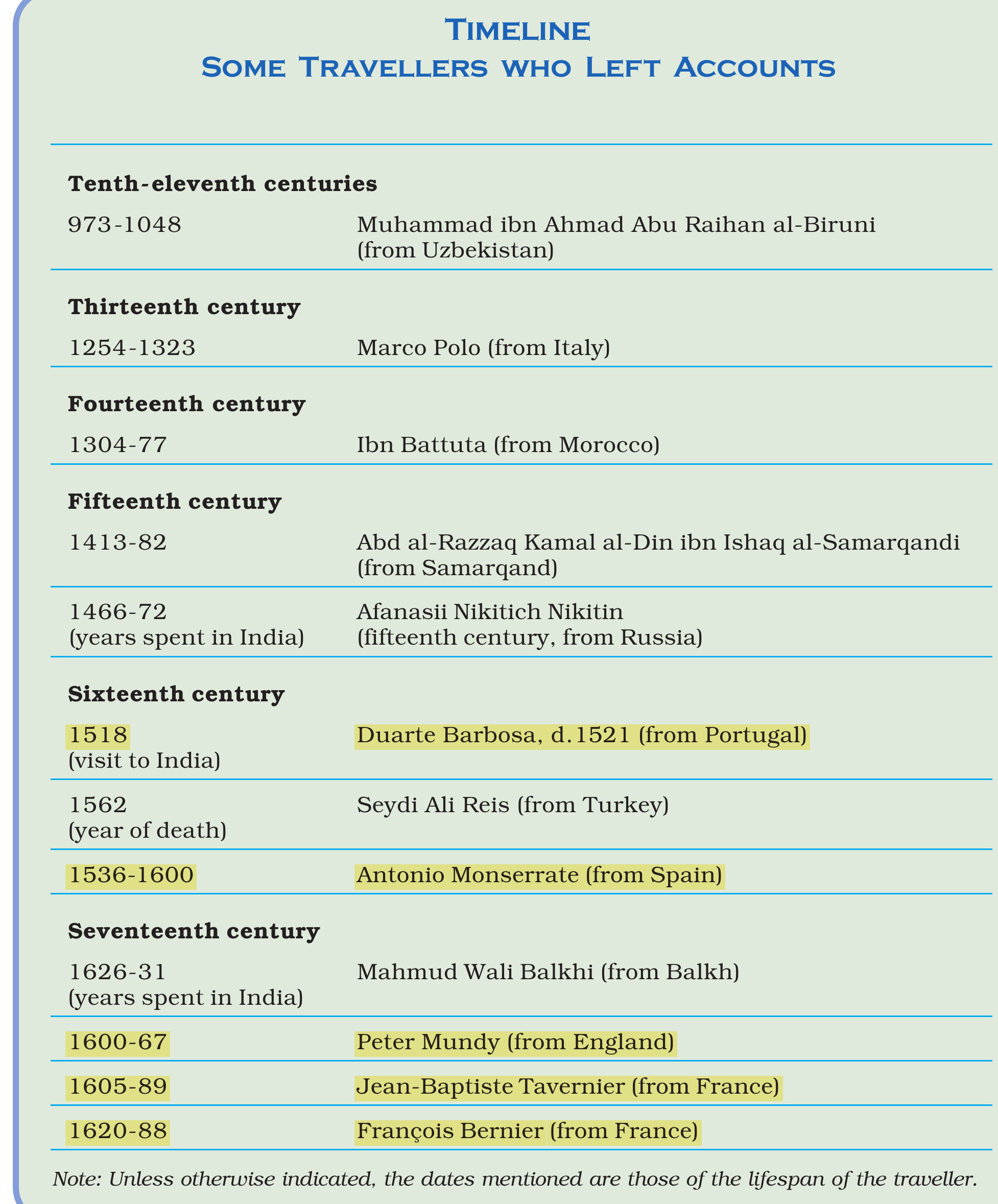
(D) Duarte Barbosa from Portugal. — visited India in 1518; he died in 1521.
(B) Antonio Monserrate from Spain. — lived from 1536 to 1600, a sixteenth-century traveller.
(E) Peter Mundy from England. — lived from 1600 to 1667, among the travellers of the seventeenth century.
(C) Jean-Baptiste Tavernier from France. — lived from 1605 to 1689; this French jeweller travelled to India at least six times.
(A) Francois Bernier from France. — lived from 1620 to 1688 and was in India for twelve years, from 1656 to 1668.
Note: The question is not properly framed. It asks for the order of the travellers’ visits, but for most of them only the years of their lifespan are given, and the lives of Peter Mundy (1600-67), Jean-Baptiste Tavernier (1605-89) and Francois Bernier (1620-88) overlap. Taking the travellers in the order of these dates, from Barbosa’s visit of 1518 to Bernier’s stay of 1656-68, only Option (4) fits. Therefore, Option (4) is the most appropriate answer.
NCERT (2026-27): “3. François Bernier … Among the best known of the Portuguese writers is Duarte Barbosa, who wrote a detailed account of trade and society in south India. Later, after 1600, we find growing numbers of Dutch, English and French travellers coming to India. One of the most famous was the French jeweller Jean-Baptiste Tavernier, who travelled to India at least six times. He was particularly fascinated with the trading conditions in India, and compared India to Iran and the Ottoman empire. Some of these travellers, like the Italian doctor Manucci, never returned to Europe, and settled down in India. François Bernier, a Frenchman, was a doctor, political philosopher and historian. Like many others, he came to the Mughal Empire in search of opportunities. He was in India for twelve years, from 1656 to 1668, and was closely associated with the Mughal court, as a physician to Prince Dara Shukoh, the eldest son of Emperor Shah Jahan, and later as an intellectual and scientist, with Danishmand Khan, an Armenian noble at the Mughal court.…”
|