Organic chemistry (Amines)
An organic compound (A) with the molecular formula C8H9NO when treated with bromine in aqueous solution of sodium hydroxide gives a new compound (B) having the molecular formula C7H9N. The compound (B) on heating with chloroform and ethanolic potassium hydroxide forms a compound (C) having foul-smelling. Further, the compound (B) gives an alkali soluble sulphonamide on reacting with benzenesulfonyl chloride.
Moreover, a thermally unstable compound (D) is obtained when the compound (B) reacts with sodium nitrite in concentrated hydrochloric acid at very low temperature. Further, the compound (D) on heating with water yields a compound which gives colour with neutral ferric chloride solution.
Answer the following questions on the basis of this passage.
The foul-smelling compound obtained by heating compound B with CHCl3 and ethanolic KOH is a
Answer & explanation
Correct answer: option 4
The correct answer is Option (4) → isocyanide
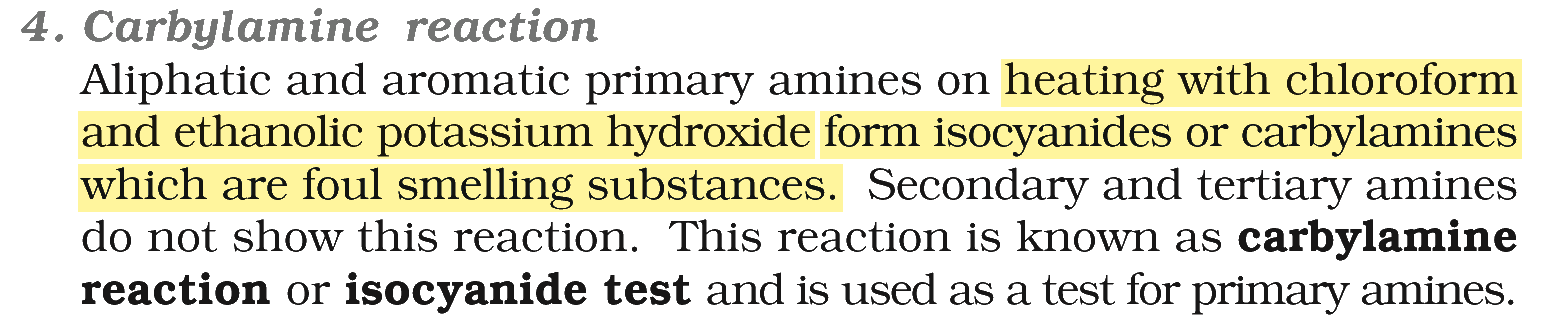
This is the carbylamine reaction, a test for primary amines, both aliphatic and aromatic. On warming with chloroform and alcoholic KOH, a primary amine gives an isocyanide (carbylamine), which has a very unpleasant smell. B is a primary amine, so it gives this test:
\( \displaystyle \ce{R-NH2 + CHCl3 + 3KOH} \xrightarrow{\text{heat}} \ce{R-NC + 3KCl + 3H2O} \)
In an isocyanide the group is bonded to the nitrogen atom, R–N≡C. So the foul-smelling compound C is an isocyanide.
Why the other options are incorrect
Option (1) amine — Incorrect. The amine is B, the compound that is tested, not the product.
Option (2) cyanide — Incorrect. A cyanide (nitrile), R–C≡N, is bonded through carbon. It is the isomer of the isocyanide and does not have its foul smell.
Option (3) amide — Incorrect. An amide (compound A) is the starting material of the Hofmann reaction, not a product of this test.
NCERT (2026-27 edition):
Carbylamine Reaction