
The angle '\( \theta \)' between the transmission directions of polariser and analyser is varied, then the intensity 'I' of the light transmitted by analyser is correctly represented by
Answer & explanation
Correct answer: option 3
The correct answer is Option (3)
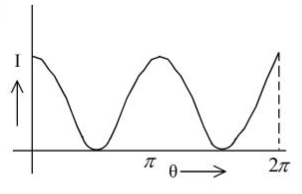
By Malus's law the intensity transmitted by the analyser is \( I = I_0\cos^{2}\theta \), where \( \theta \) is the angle between the transmission directions of the polariser and the analyser.
The graph for \( \theta \) from 0 to \( 2\pi \) must therefore have these features:
\( \theta = 0 \): \( I = I_0 \) (maximum)
\( \theta = \pi/2 \): \( I = 0 \)
\( \theta = \pi \): \( I = I_0 \) (maximum)
\( \theta = 3\pi/2 \): \( I = 0 \)
\( \theta = 2\pi \): \( I = I_0 \) (maximum)
The curve starts at its maximum, falls to zero at \( \pi/2 \), is again at its maximum at \( \pi \), and has two minima in the interval. The intensity is never negative. Only the graph of Option (3) does this.
Why the other options are incorrect
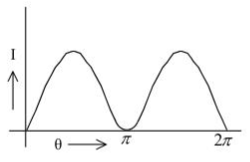
Option (1) — Incorrect. The intensity is zero at \( \theta = 0 \) and at \( \pi \), with maxima in between. That is the behaviour of \( \sin^{2}\theta \), but at \( \theta = 0 \) the axes are parallel and the intensity must be maximum.
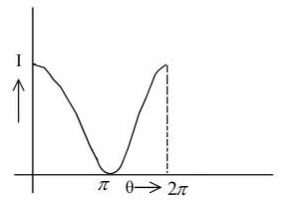
Option (2) — Incorrect. It starts at a maximum but has only one minimum, at \( \pi \), in the whole interval; the intensity should vanish twice, at \( \pi/2 \) and \( 3\pi/2 \).
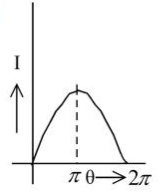
Option (4) — Incorrect. It starts from zero at \( \theta = 0 \), rises to a single maximum at \( \pi \) and returns to zero; at \( \theta = 0 \) the intensity must be maximum, and there must be two maxima.
NCERT (2026-27):
Polarisation – “… If the pass-axis of P2 makes an angle θ with the pass-axis of P1, then when the polarised beam passes through the polaroid P2, the component E cos θ (along the pass-axis of P2) will pass through P2. Thus, as we rotate the polaroid P1 (or P2), the intensity will vary as:
\( \displaystyle I = I_0 \cos^2\theta \qquad (10.18) \)
where I0 is the intensity of the polarized light after passing through P1. This is known as Malus’ law.”