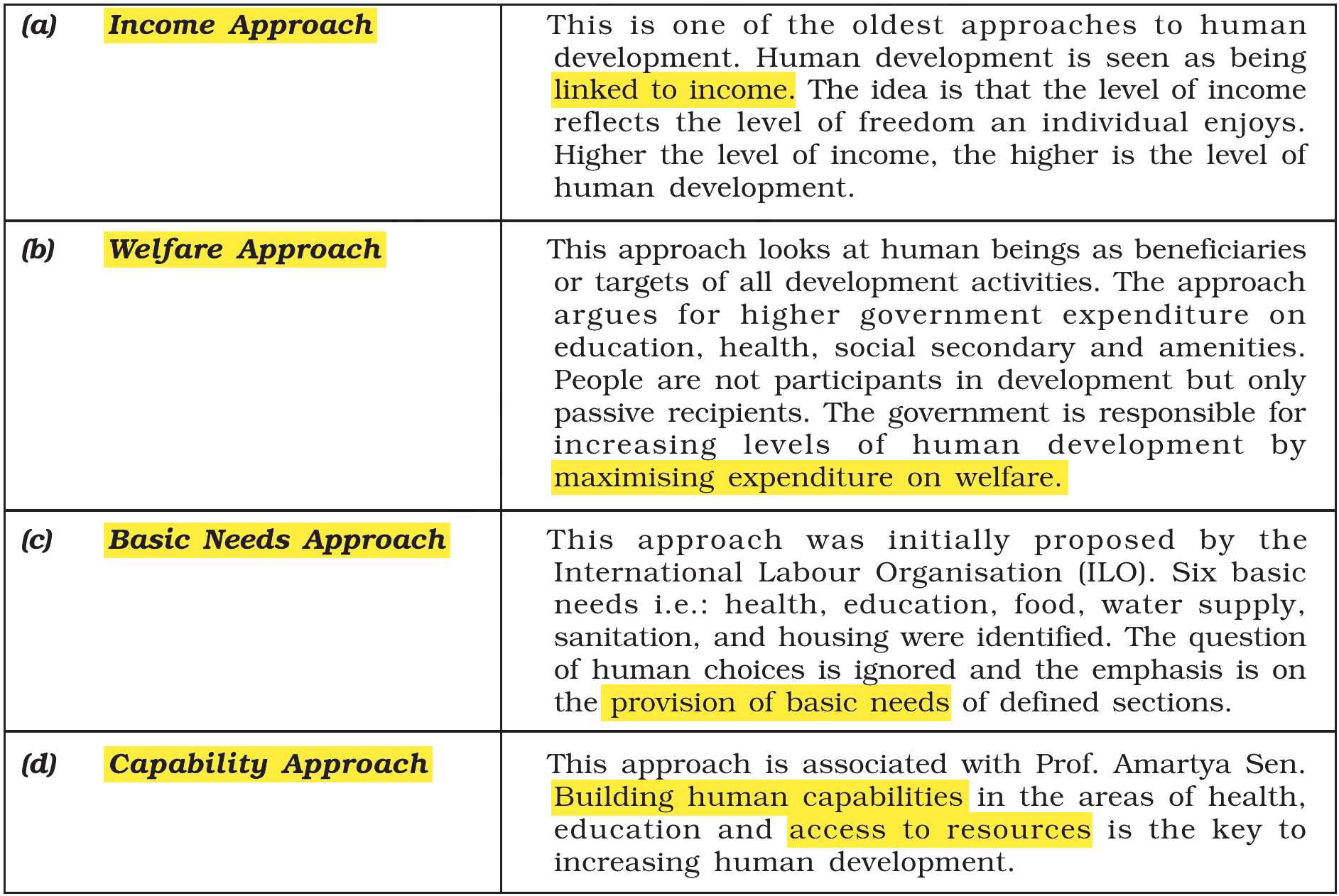
Match List - I with List - II.
| List – I | List – II | ||
| (Approach) | (Focus) | ||
| (A) | Income Approach | (I) | Focus on provision of basic needs |
| (B) | Welfare Approach | (II) | Build human capabilities and access to resources |
| (C) | Basic Needs Approach | (III) | Maximum expenditure on welfare |
| (D) | Capability Approach | (IV) | Human development linked to income |
Choose the correct answer from the options given below:
Answer & explanation
Correct answer: option 1
The correct answer is Option (1) → (A)-(IV), (B)-(III), (C)-(I), (D)-(II)
(A) Income Approach — this matches (IV) Human development linked to income. The higher the income, the higher the level of human development.
(B) Welfare Approach — this matches (III) Maximum expenditure on welfare. The government raises human development by spending as much as it can on welfare.
(C) Basic Needs Approach — this matches (I) Focus on provision of basic needs. It stresses six basic needs: health, education, food, water supply, sanitation and housing.
(D) Capability Approach — this matches (II) Build human capabilities and access to resources. Associated with Prof. Amartya Sen, it builds capabilities in health, education and access to resources.
NCERT (2026-27):
Table 3.1: Approaches to Human Development |