
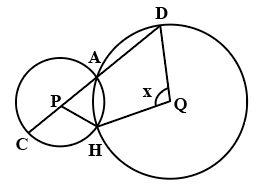
In the following figure, P and Q are centres of two circles. The circles are intersecting at points A and B. PA produced on both the sides meets the circles at C and D. If ∠CPB=100°, then find the value of x.
Answer & explanation
Correct answer: option 4
In the given figure,
\(\angle\)CPB = \({100}^\circ\)
So, \(\angle\)APB = \({80}^\circ\) [As, \(\angle\)APB = Supplementary Angle of \(\angle\)CPB ]
Now, in \(\Delta \)APB,
AP = PB = radius of the smaller circle
So, \(\angle\)PAB = \(\angle\)PBA
\(\angle\)PAB = [(\({180}^\circ\) - \({80}^\circ\))/2]
⇒ \(\angle\)PAB = \({50}^\circ\)
Now,
\(\angle\)DAB = \({180}^\circ\) - \({50}^\circ\)
⇒ \(\angle\)DAB = \({130}^\circ\) [As, \(\angle\)DAB = Supplementary Angle of \(\angle\)PAB ]
As ABRD is a cyclic quadrilateral
So, \(\angle\)BRD = \({180}^\circ\) - \({130}^\circ\) = \({50}^\circ\)
Now,
According to the concept,
\(\angle\)BQD = 50 x 2 = \({100}^\circ\) i.e; x
Therefore, value of x is \({100}^\circ\).