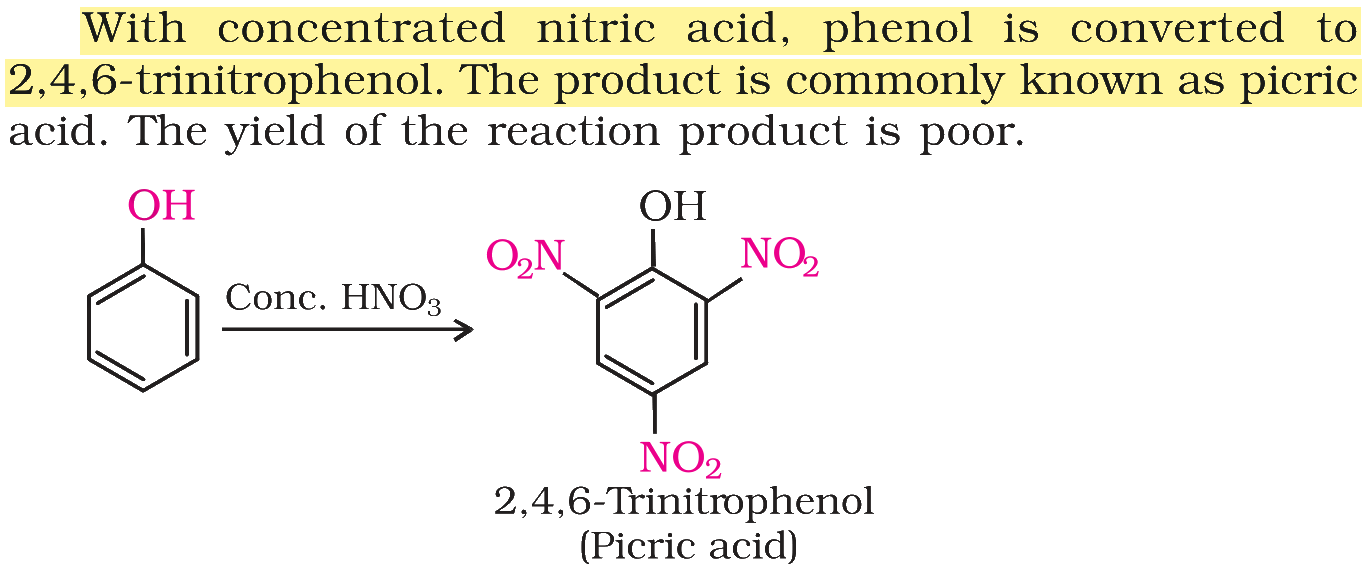
What product is formed when phenol is treated with conc. \( HNO_3 \)?

Answer & explanation
Correct answer: option 1
The correct answer is Option (1) → 2,4,6-trinitrophenol (picric acid)
The –OH group strongly activates the benzene ring and directs electrophiles to the ortho and para positions. How far nitration goes depends on the strength of the nitric acid:
With dilute nitric acid at 298 K, one nitro group enters, giving a mixture of 2-nitrophenol and 4-nitrophenol.
With concentrated nitric acid, all three ortho and para positions are nitrated, giving 2,4,6-trinitrophenol, known as picric acid.
\( \displaystyle \ce{C6H5OH + 3HNO3} \xrightarrow{\text{conc.}} \ce{C6H2(NO2)3OH + 3H2O} \)
The yield of this direct reaction is poor, because concentrated nitric acid also oxidises phenol. Picric acid is now made by sulphonating phenol first (to phenol-2,4-disulphonic acid) and then treating it with concentrated nitric acid. With three electron withdrawing –\( \ce{NO2} \) groups, picric acid is a strong acid.
Why the other options are incorrect
Option (2) 4-nitrophenol — Incorrect. This mononitro product is formed with dilute nitric acid at low temperature, together with 2-nitrophenol.
Option (3) 2-nitrophenol — Incorrect. This too is a product of nitration with dilute nitric acid; with the concentrated acid nitration does not stop at one nitro group.
Option (4) 3-nitrophenol — Incorrect. The –OH group does not direct the electrophile to the meta position, so 3-nitrophenol is not formed by nitrating phenol.
NCERT (2026-27 edition):
Electrophilic Aromatic Substitution – …