Match List-I with List-II.
| List-I (Reaction) | List-II (Product) |
|---|---|
| (A) Ethanal with dilute NaOH | (I) 4-Methylpent-3-en-2-one |
| (B) Propanone with \( \ce{Ba(OH)2} \) | (II) 3-Hydroxybutanal |
| (C) Ethanal with dilute NaOH, followed by heating | (III) But-2-enal |
| (D) Propanone with \( \ce{Ba(OH)2} \), followed by heating | (IV) 4-Hydroxy-4-methylpentan-2-one |
Choose the correct answer from the options given below:
Answer & explanation
Correct answer: option 3
The correct answer is Option (3) → A-II, B-IV, C-III, D-I
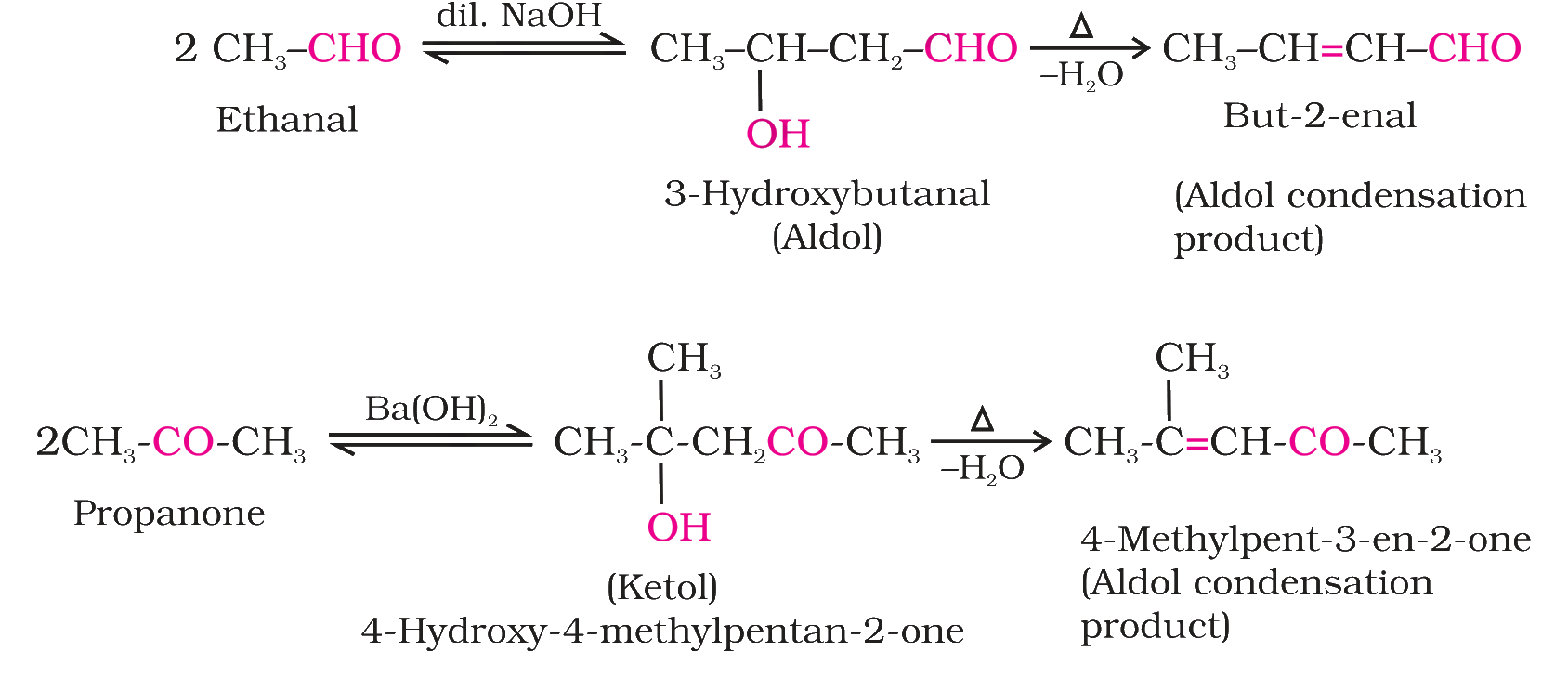
Ethanal and propanone both have α-hydrogens, so with a dilute base two molecules join to give a β-hydroxy carbonyl compound (aldol or ketol). On heating, this loses water to give an α,β-unsaturated carbonyl compound, the aldol condensation product.
\( \displaystyle \ce{2CH3CHO <=>[\text{dil. NaOH}] CH3CH(OH)CH2CHO} \xrightarrow[-\ce{H2O}]{\Delta} \ce{CH3CH=CHCHO} \)
\( \displaystyle \ce{2CH3COCH3 <=>[\ce{Ba(OH)2}] (CH3)2C(OH)CH2COCH3} \xrightarrow[-\ce{H2O}]{\Delta} \ce{(CH3)2C=CHCOCH3} \)
(A) Ethanal with dilute NaOH — This matches (II) 3-Hydroxybutanal, the aldol.
(B) Propanone with Ba(OH)2 — This matches (IV) 4-Hydroxy-4-methylpentan-2-one, the ketol.
(C) Ethanal with dilute NaOH, followed by heating — This matches (III) But-2-enal. The aldol loses water and a C=C bond forms between C-2 and C-3.
(D) Propanone with Ba(OH)2, followed by heating — This matches (I) 4-Methylpent-3-en-2-one. The ketol loses water in the same way.
NCERT (2026-27 edition):
8.4 Chemical Reactions – “(i) Aldol condensation: Aldehydes and ketones having at least one α-hydrogen undergo a reaction in the presence of dilute alkali as catalyst to form β-hydroxy aldehydes (aldol) or β-hydroxy ketones (ketol), respectively. This is known as Aldol reaction.”
“…The aldol and ketol readily lose water to give α,β-unsaturated carbonyl compounds which are aldol condensation products and the reaction is called Aldol condensation.”