Statement I: The spin-only magnetic moment of Sc3+ is 1.73 BM.
Statement II: The spin-only magnetic moment (in BM) of an ion is equal to \(\sqrt{n(n+2)}\), where n is the number of unpaired electrons present in the ion.
Answer & explanation
Correct answer: option 4
The correct answer is Option (4) → Statement I is false but statement II is true
The spin-only magnetic moment of an ion depends only on the number of unpaired electrons n in it.
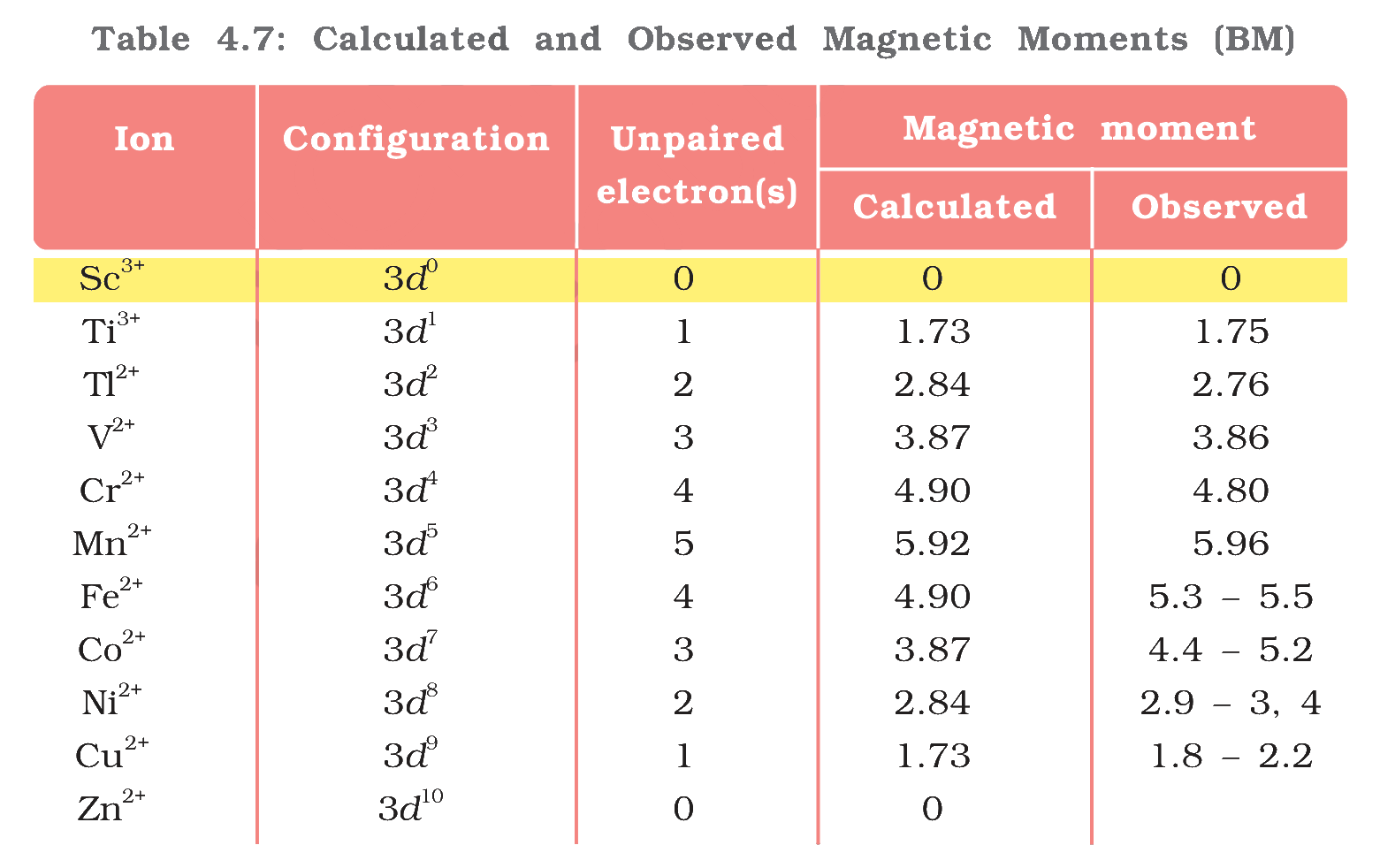
Statement I: The spin-only magnetic moment of Sc3+ is 1.73 BM. — False.
Configuration: scandium (Z = 21) is [Ar]3d14s2.
Electrons removed: the two 4s electrons and the one 3d electron, giving \( \ce{Sc^3+} \): 3d0.
Unpaired electrons: n = 0.
Magnetic moment: \( \mu=\sqrt{0(0+2)}=0 \); \( \ce{Sc^3+} \) is diamagnetic. The value 1.73 BM belongs to an ion with one unpaired electron, such as \( \ce{Ti^3+} \) (3d1).
Statement II: The spin-only magnetic moment (in BM) of an ion is equal to \( \sqrt{n(n+2)} \), where n is the number of unpaired electrons present in the ion. — True. This is the ‘spin-only’ formula, used for ions of the first transition series, where the orbital contribution is quenched.
NCERT (2026-27 edition):
4.3.9 Magnetic Properties – “… For these, the magnetic moment is determined by the number of unpaired electrons and is calculated by using the ‘spin-only’ formula, i.e., \( \mu=\sqrt{n(n+2)} \) where n is the number of unpaired electrons and μ is the magnetic moment in units of Bohr magneton (BM). A single unpaired electron has a magnetic moment of 1.73 Bohr magnetons (BM).”
Table 4.7: Calculated and Observed Magnetic Moments (BM)