According to Keynes, equilibrium level of Income is achieved when ___________.
Answer & explanation
Correct answer: option 2
The correct answer is Option (2) → Planned Savings = Planned Investment
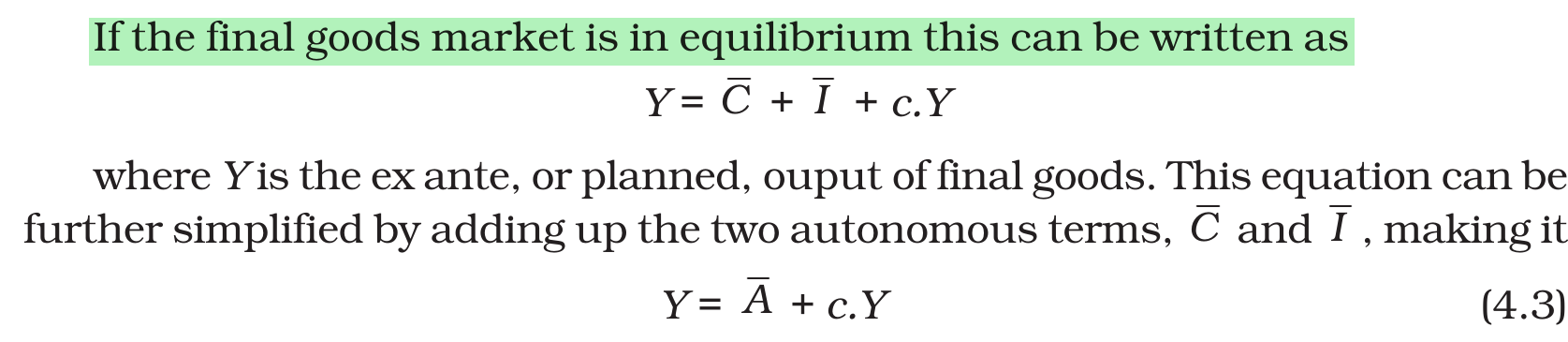
Income (Y) is in equilibrium when planned spending equals output. Planned spending is consumption (C) plus investment (I), so Y = C + I. The income that is not consumed is saved (S), so Y − C = S. Putting the two together gives S = I. Here S and I are the planned values, also called ex ante values.
Option (1) Planned Savings > Planned Investment — Incorrect. Planned spending then falls short of output, so stocks pile up in warehouses. Firms cut production and income falls.
Option (2) Planned Savings = Planned Investment — Correct. What people plan to save is what firms plan to invest. So all output is bought as planned, and income has no reason to change.
Option (3) Planned Savings < Planned Investment — Incorrect. Planned spending is then more than output, so stocks run down. Firms raise production and income rises.
Option (4) Income = Consumption — Incorrect. Here all income is consumed, so saving is zero. With any planned investment, planned spending would be more than income.
NCERT (2026-27): “4.1.1. Consumption … Let us also look at another dimension of this, savings. Savings is that part of income that is not consumed. In other words, S ≡ Y − C… 4.2 Determination of Income in Two-sector Model In an economy without a government, the ex ante aggregate demand for final goods is the sum total of the ex ante consumption expenditure and ex ante investment expenditure on such goods, viz. AD = C + I. … …A word of caution is in order. The term Y on the left hand side of equation (4.3) represents the ex ante output or the planned supply of final goods. On the other hand, the expression on the right hand side denotes ex ante or planned aggregate demand for final goods in the economy. Ex ante supply is equal to ex ante demand only when the final goods market, and hence the economy, is in equilibrium. … If ex ante demand for final goods falls short of the output of final goods that the producers have planned to produce in a given year, equation (4.3) will not hold. Stocks will be piling up in the warehouses which we may consider as unintended accumulation of inventories.…”
|