
CUETMOCK
  • Pricing
  • Mentors
Log inStart freeStart free mocks→

First test, then trust

Try a free CUET mock test.

Join 5,00,000+ students who rehearsed exam day on the exact NTA screen before sitting CUET. On the web and on Android.

Start free mocks →Get the Android app
CUETMOCK

India's #1 CUET Mock Test Platform. Original NCERT-based questions on the exact NTA exam screen — trusted by 5,00,000+ students since CUET 2022.

Get it onGoogle PlayScan to download the CUETMOCK app

Mock tests

  • CUET mock test series
  • Commerce mocks
  • Humanities (Arts) mocks
  • Science mocks
  • Languages & GAT mocks
  • Free practice questions
  • Pricing

Resources

  • CUET exam guide
  • CUET syllabus
  • Universities accepting CUET
  • Expert blogs
  • News & notifications
  • Webinars & counselling
  • CUET score calculator
  • How we estimate your rank
  • FAQs

Company

  • About us
  • Our leadership & team
  • Our toppers
  • Mentors
  • For schools
  • Contact us
  • Terms
  • Privacy
  • Refund policy

Talk to us

+91 7696 6630 56info@cuetmock.comWhatsApp us

Our other platforms

  • JEE Mock — For IIT-JEE aspirants
  • NEET Mock — For NEET aspirants

Newsletter

Exam updates, study material and offers — no spam.

© 2026 NYC Ventures Pvt. Ltd.

701-702, Royal Business Park, Zirakpur, Punjab - 140603

  • Terms of use
  • Privacy policy
  • Refund policy
  • Contact us

iCUETMOCK is an independent preparation platform, not affiliated with the National Testing Agency (NTA). Always check exam details on the official NTA website.

  • Home
  • Mock tests
  • CUET guide
  • Pricing
  • Log in
Home/Practice questions/Chemistry
ChemistryInorganic: Coordination Compounds

Which of the following is not true about metal carbonyls?

Which of the following is not true about metal carbonyls?

Answer & explanation+

Correct answer: option 4

The correct answer is Option (4) → pπ–pπ back bonding takes place

The metal–carbon bond in a metal carbonyl has σ and π character. A Lewis base donates an electron pair and a Lewis acid accepts one.

  • σ bond (CO → M): the lone pair on the carbon of CO is donated into a vacant metal orbital.

  • π bond (M → CO), back bonding: a pair of electrons from a filled d orbital of the metal is donated into the vacant antibonding π* orbital of CO, which is built from p orbitals. This is dπ–pπ overlap.

Option (1) CO acts as a Lewis base as well as a Lewis acid — True about metal carbonyls. CO donates its carbon lone pair (Lewis base) and accepts metal d electrons into its π* orbital (Lewis acid).

Option (2) The metal acts as a Lewis base as well as a Lewis acid — True about metal carbonyls. The metal accepts the lone pair of CO (Lewis acid) and donates its d electrons back to CO (Lewis base).

Option (3) dπ–pπ back bonding takes place — True about metal carbonyls. The back donation goes from a metal d orbital to the p-based π* orbital of CO.

Option (4) pπ–pπ back bonding takes place — Not true about metal carbonyls. The metal gives the back-bonding electrons from a d orbital, not a p orbital, so the overlap is dπ–pπ.

NCERT (2026-27 edition):
5.6 Bonding in Metal Carbonyls – “The metal-carbon bond in metal carbonyls possess both σ and π character. The M–C σ bond is formed by the donation of lone pair of electrons on the carbonyl carbon into a vacant orbital of the metal. The M–C π bond is formed by the donation of a pair of electrons from a filled d orbital of metal into the vacant antibonding π* orbital of carbon monoxide. The metal to ligand bonding creates a synergic effect which strengthens the bond between CO and the metal (Fig.5.14).”
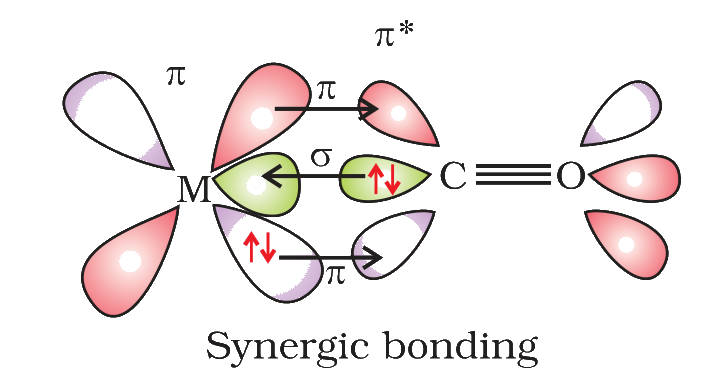
Fig. 5.14

Fig. 5.14: Example of synergic bonding interactions in a carbonyl complex

Advertisement

Practise more on Inorganic: Coordination Compounds

Chapter-wise mocks on the real NTA exam screen, with solutions and your rank. Your first mocks are free.

Start free mocks →

Advertisement

Next questions

  1. Ram can do a piece of work in 3 days. Shyam can do 3 times the same work in 8 days, and Rohit can do 5 times the same work in 12 days. If a…General Aptitude Test · Numerical Ability
  2. In Young’s double-slit experiment, what will be the phase difference between the light waves reaching the third bright fringe from the cent…Physics · Wave Optics
  3. A cylindrical rod of iron, whose height is equal to the radius of its base, is melted and cast into spherical balls, each of whose radius i…General Aptitude Test · Quantitative Reasoning
  4. Who was the “Shroff” as mentioned by the seventeenth-century French traveller Jean-Baptiste Tavernier?History · Medieval India: Peasants, Zamindars and the State
  5. Siya, Suresh and Seema are partners in a firm sharing profits and losses in the ratio of 3:2:1. Seema retires from the firm and the new pro…Accountancy Part A · Reconstitution of Partnership Firm: Retirement and Death
  6. निम्नलिखित में से 'शब्द और विलोम' के शुद्ध युग्मों की पहचान कीजिए- (A) भाव - अभाव(B) मानवीय - अमानवीय(C) बाल - युवा(D) बिक्री - खरीद(E) भोल…Hindi · विलोम शब्द
  7. If 18th February 1997 fell on Tuesday then what was the day on 18th February 1999?General Aptitude Test · Verbal Reasoning
  8. By giving an example of which country did Al-Biruni attempt to suggest that social divisions were not unique to India?History · Medieval India: Through the Eyes of Travellers
  9. उदारवादी स्थापना को मूर्त रूप देने के लिए किस प्रकार के साक्ष्य की आवश्यकता थी?Hindi · Comprehension - (Narrative / Factual)
  10. Pick the figure from the options that best continues the given figure series.General Aptitude Test · Non-Verbal Reasoning