Which of the following is not a step of Polymerase Chain Reaction?
Answer & explanation
Correct answer: option 2
The correct answer is Option (2) → Downstream processing
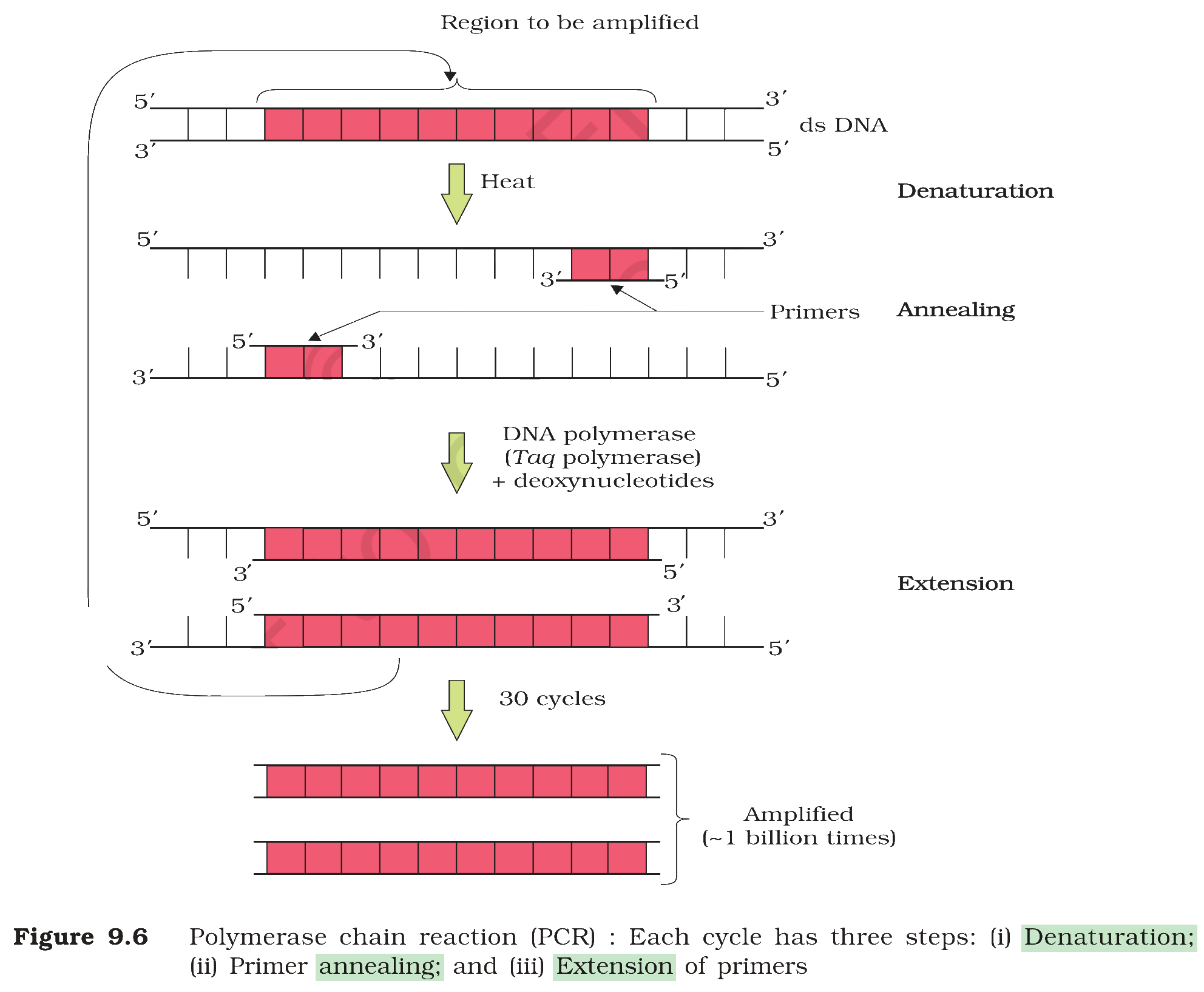
The polymerase chain reaction (PCR) makes many copies of a piece of DNA in a test tube. Each cycle has three steps, and the cycle is repeated about 30 times.
Option (1) Extension — A step of PCR.
Option (2) Downstream processing — Not a step of PCR. Downstream processing is the separation and purification of a product after it has been made in a bioreactor. The product is then formulated and tested before it is sold. It belongs to large-scale production, not to copying DNA.
Option (3) Annealing — A step of PCR.
Option (4) Denaturation — A step of PCR.
NCERT Extract:
Amplification of Gene of Interest using PCR – “PCR stands for Polymerase Chain Reaction. In this reaction, multiple copies of the gene (or DNA) of interest is synthesised in vitro using two sets of primers (small chemically synthesised oligonucleotides that are complementary to the regions of DNA) and the enzyme DNA polymerase. The enzyme extends the primers using the nucleotides provided in the reaction and the genomic DNA as template. If the process of replication of DNA is repeated many times, the segment of DNA can be amplified to approximately billion times, i.e., 1 billion copies are made.”