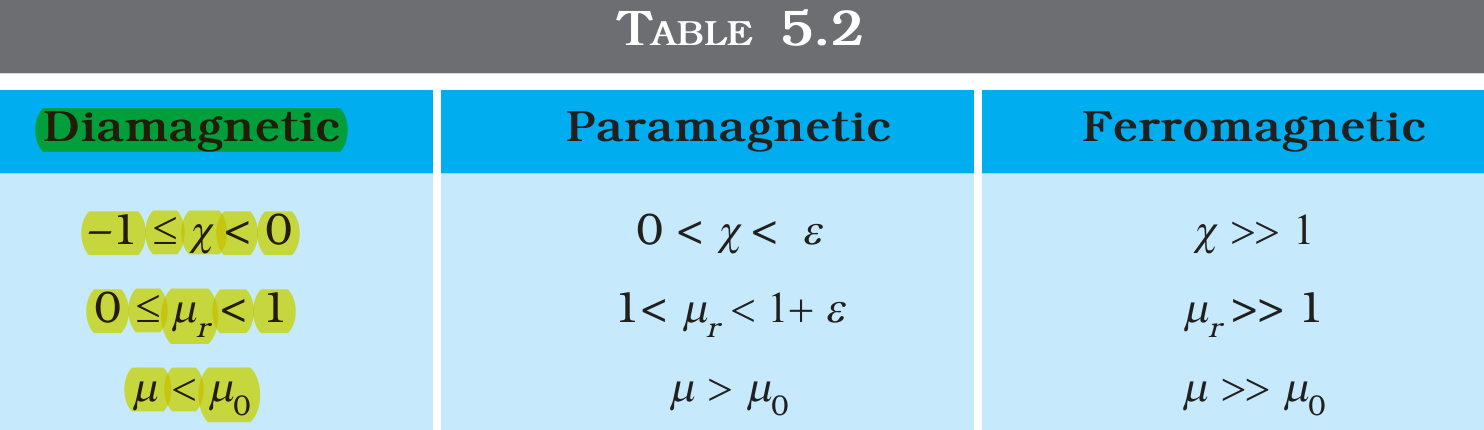
For diamagnetic materials
(A) \( \mu \gt \mu_{0} \)
(B) \( -1 \le \chi \lt 0 \)
(C) \( 0 \le \mu_{r} \lt 1 \)
(D) \( \mu \lt \mu_{0} \)
Choose the correct answer from the options given below:
Answer & explanation
Correct answer: option 4
The correct answer is Option (4) → (B), (C) and (D) only
A diamagnetic material is weakly repelled by a magnet: its magnetisation is opposite to the applied field, so its susceptibility is negative.
\( \mu_{r} = 1 + \chi \)
\( \mu = \mu_{r}\mu_{0} \)
(A) \( \mu \gt \mu_{0} \) — Incorrect. \( \mu \gt \mu_{0} \) (that is, \( \mu_{r} \gt 1 \)) describes paramagnetic and ferromagnetic materials.
(B) \( -1 \le \chi \lt 0 \) — Correct. \( \chi \) is small and negative; the limit \( \chi = -1 \) is a superconductor, a perfect diamagnet that expels the field completely.
(C) \( 0 \le \mu_{r} \lt 1 \) — Correct. This follows from (B) through \( \mu_{r} = 1 + \chi \).
(D) \( \mu \lt \mu_{0} \) — Correct. Since \( \mu_{r} \lt 1 \), \( \mu = \mu_{r}\mu_{0} \) is less than \( \mu_{0} \).
NCERT (2026-27):
Magnetic Properties of Materials – …