
Rate law
Rate law is the expression in which reaction rate is given in terms of molar concentration of reactants, with each term raised to some power, which may or may not be same as the stoichiometric coefficient of the reacting species in a balanced chemical equation. The sum of powers of the concentration of the reactants, in the rate law expression is called the order of that chemical reaction. The number of reacting species (atoms, ions, or molecules) taking part in an elementary reaction, which must collide simultaneously in order to bring about a chemical reaction, is called molecularity of a reaction.
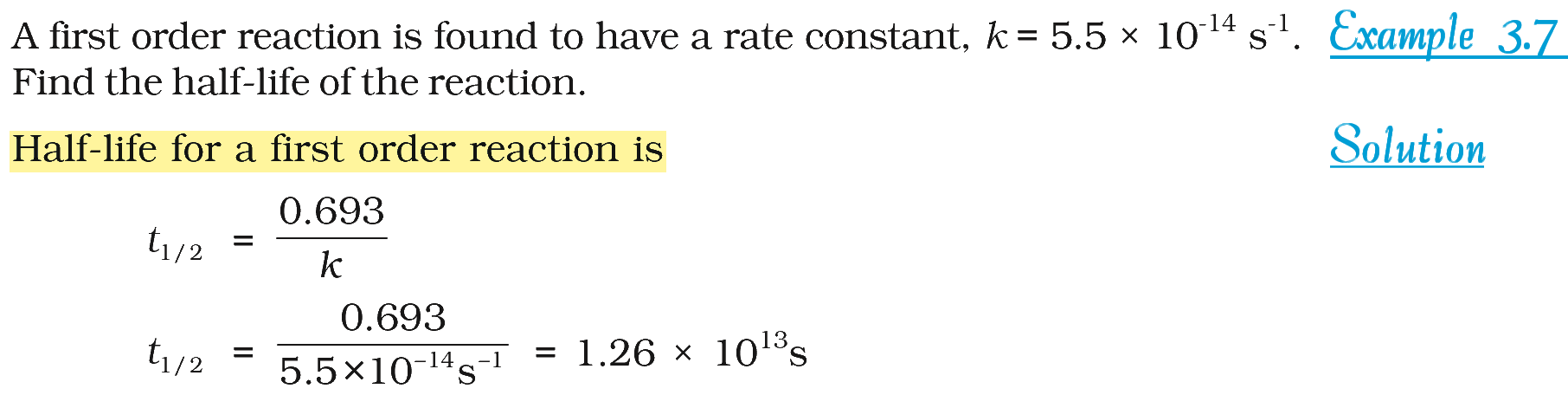
A first order reaction is found to have a rate constant, k = 5.5 × 10⁻¹⁴ s-1. Find the half-life of the reaction.
Answer & explanation
Correct answer: option 4
The correct answer is Option (4) → 1.26 × 10¹³ s
The unit of the rate constant tells the order of a reaction. For Rate = k[A]n, the unit of k is (mol L−1)1−n s−1, so a rate constant in s−1 belongs to a first order reaction.
For a first order reaction the integrated rate equation is
\( \displaystyle k=\frac{2.303}{t}\log\frac{[R]_0}{[R]} \)
At the half-life, [R] = [R]0/2, so
\( \displaystyle t_{1/2}=\frac{2.303}{k}\log 2=\frac{2.303\times0.3010}{k} \)
\( \displaystyle t_{1/2}=\frac{0.693}{k} \)
The half-life of a first order reaction does not depend on the initial concentration. Here k = 5.5 × 10⁻¹⁴ s−1:
\( \displaystyle t_{1/2}=\frac{0.693}{5.5\times10^{-14}\ \mathrm{s^{-1}}} \)
\( \displaystyle t_{1/2}=0.126\times10^{14}\ \mathrm{s} \)
\( \displaystyle t_{1/2}=1.26\times10^{13}\ \mathrm{s} \)
So the half-life of the reaction is 1.26 × 10¹³ s.
Shortcut: 0.693/5.5 ≈ 0.126, which fixes the digits 1.26 and rules out Options (1) and (3). Dividing by 10−14 multiplies by 1014, and 0.126 × 1014 = 1.26 × 10¹³, which is Option (4).
Note 1: This question is from NCERT (2026-27). NTA sets numerical questions from NCERT too, so do not ignore NCERT while practising numericals.
NCERT (2026-27 edition):
Half-Life of a Reaction – …
Note 2: The same/similar question has been asked in different years by NTA as per the details given below:
| 2026 | 2025 | 2024 | 2023 | 2022 |
|---|---|---|---|---|
| 25-05 S2 22-05 S1 | 16-05 S1 | – | 20-06 S3 | – |