Acetone can be prepared by the oxidation of
Answer & explanation
Correct answer: option 2
The correct answer is Option (2) → Isopropyl alcohol
Oxidation of an alcohol removes the hydrogen of the –OH group and a hydrogen from the carbon carrying it, so the product depends on the class of the alcohol:
a primary alcohol gives an aldehyde, which can be oxidised further to a carboxylic acid;
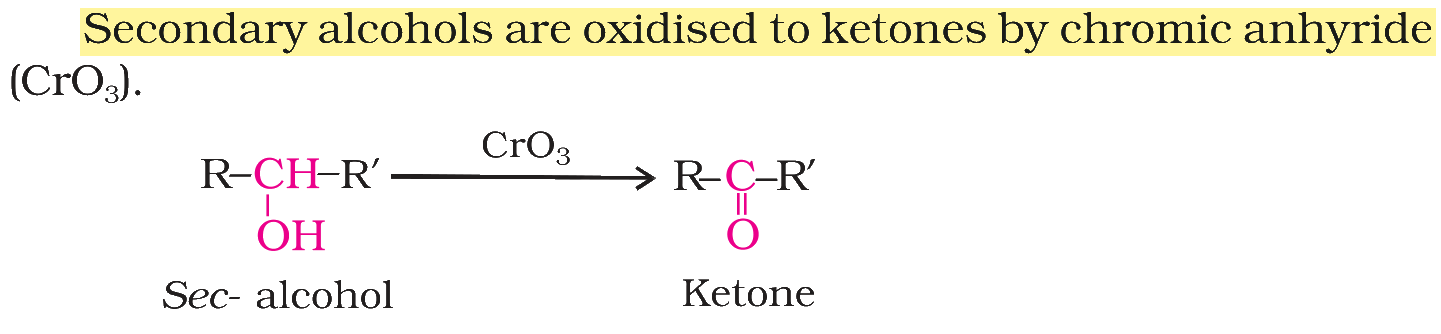
a secondary alcohol gives a ketone;
a tertiary alcohol has no H on the carbinol carbon and is not oxidised under these conditions.
Acetone (propanone) is a ketone with the carbonyl group on the middle carbon, so it comes from the secondary alcohol with the –OH on the middle carbon, isopropyl alcohol (propan-2-ol). Chromic anhydride (\( \ce{CrO3} \)), acidified dichromate, or hot copper at 573 K can do this:
\( \displaystyle \ce{CH3-CH(OH)-CH3} \xrightarrow{\ce{CrO3}} \ce{CH3-CO-CH3} \)
Why the other options are incorrect
Option (1) Methanol — Incorrect. A primary alcohol with one carbon; it is oxidised to methanal (formaldehyde), \( \ce{CH3OH -> HCHO} \).
Option (3) Propanol — Incorrect. Propan-1-ol is a primary alcohol; it gives propanal and then propanoic acid, not a ketone, \( \ce{CH3CH2CH2OH -> CH3CH2CHO} \).
Option (4) Ethanol — Incorrect. A primary alcohol with two carbons; it gives ethanal and then ethanoic acid, \( \ce{CH3CH2OH -> CH3CHO} \).
NCERT (2026-27 edition):
Chemical Reactions – …