Read the passage and answer the following questions:-
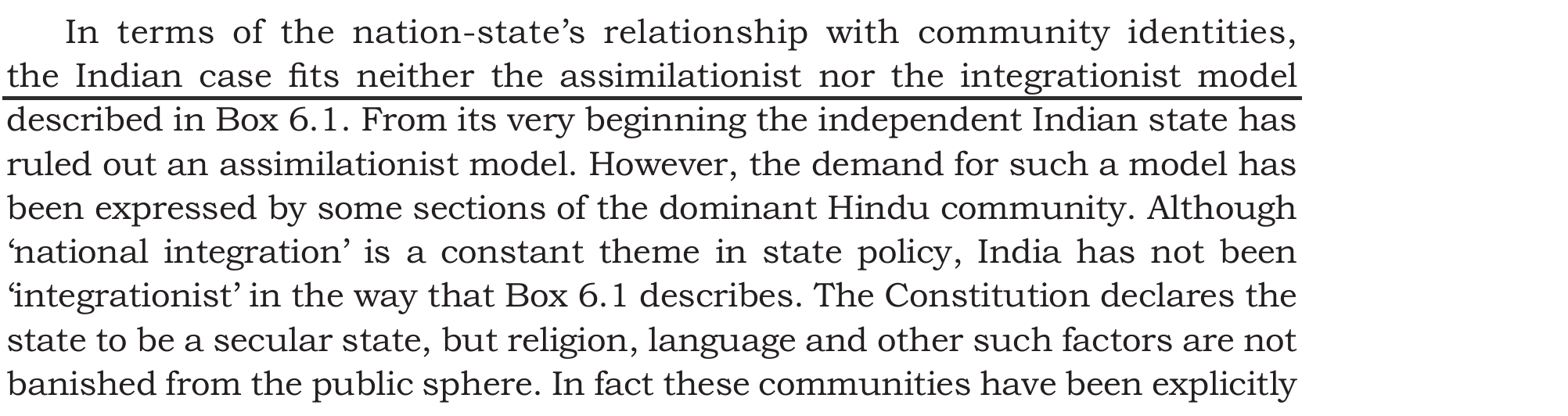
In terms of the nation-state's relationship with community identities, the Indian case fits neither the assimilationist nor the integrationist model described in Box 6.2. From its very beginning the independent Indian state has ruled out an assimilationist model. However, the demand for such a model has been expressed by some sections of the dominant Hindu community. Although 'nationalist' integration is a constant theme in state policy, India has not been integrationist in the way that Box 6.2 describes. The constitution declares the state to be a secular state, but religion, language and other such factors are not banished from the public sphere. In fact these communities have been explicitly recognised by the state. By international standards, very strong constitutional protection is offered to minority religions. In general India's problems have been more in the sphere of implementation and practice rather than laws or principles. But on the whole, India can be considered a good example of a state nation though it is not entirely free from the problems common to nation states.
The manner in which diversity in India is politically managed can be considered to be an example of which of the following?
Answer & explanation
Correct answer: option 3
The correct answer is Option (3) → State nation
Option (1) Integrationist state — Incorrect. An integrationist state keeps public culture to a common national pattern and relegates all ‘non-national’ cultures to the private sphere. In India, religion, language and other such factors are not banished from the public sphere.
Option (2) Assimilationist state — Incorrect. An assimilationist state presses all citizens to adopt the dominant group’s values. The independent Indian state ruled out this model from its very beginning, though some sections of the dominant Hindu community have demanded it.
Option (3) State nation — Correct. A ‘state-nation’ is a state in which various ‘nations’ – ethnic, religious, linguistic or indigenous identities – co-exist peacefully and cooperatively in a single state polity. India recognises its communities explicitly and protects its minority religions, so on the whole it can be considered a good example of a ‘state-nation’.
Option (4) Complementary state — Incorrect. There is no such term. The word ‘complementary’ comes in the idea of multiple and complementary identities that a state-nation builds; it does not name a kind of state.
NCERT: Indian Society — Chapter 6: The Challenges of Cultural Diversity (2025-26)
|