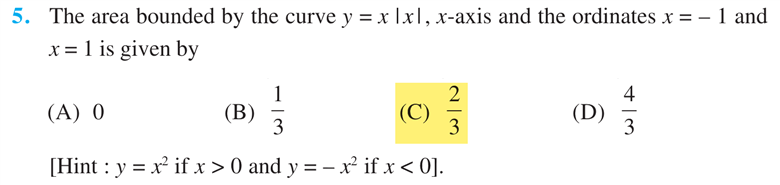
The area bounded by the curve \(y=x|x|\), x-axis and the ordinates \(x=-1\) and \(x=1\) is given by :
Answer & explanation
Correct answer: option 3
The correct answer is Option (3) → \(\displaystyle\frac{2}{3}\)
Removing the modulus:
\( y = x|x| = \begin{cases} x^2, & x \ge 0\\ -x^2, & x \lt 0 \end{cases} \)
The curve is above the x-axis for x > 0 and below it for x < 0. An area is always positive, so each part is taken with a positive sign:
\( \displaystyle \text{Area} = \int_{-1}^{0} \left|-x^2\right| dx + \int_{0}^{1} x^2\,dx \)
\( \displaystyle = \left[\frac{x^3}{3}\right]_{-1}^{0} + \left[\frac{x^3}{3}\right]_{0}^{1} \)
\( \displaystyle = \frac{1}{3} + \frac{1}{3} = \frac{2}{3} \)
Why the other options are incorrect
Option (1) 0 — Incorrect. This is \(\int_{-1}^{1} x|x|\,dx\), which is 0 because x|x| is odd: the part below the axis cancels the part above. An area is not cancelled.
Option (2) \(\displaystyle\frac{1}{3}\) — Incorrect. This is the area of one side only, from 0 to 1.
Option (4) \(\displaystyle\frac{4}{3}\) — Incorrect. The two equal parts give \(\frac{1}{3} + \frac{1}{3} = \frac{2}{3}\), half of this value.
NCERT (2026-27 edition):
Application of Integrals