Statement I: As the size of the halogen atom increases from fluorine to iodine, the carbon–halogen bond length increases from C–F to C–I.
Statement II: Among the carbon–halogen bonds, the C–I bond has the highest bond enthalpy.
In the light of the above statements, choose the correct answer from the options given below:
Answer & explanation
Correct answer: option 1
The correct answer is Option (1) → Only Statement I is correct.
Down group 17 the halogen atom becomes larger. A larger atom forms a longer bond with carbon, and a longer bond is weaker, so it needs less energy to break.
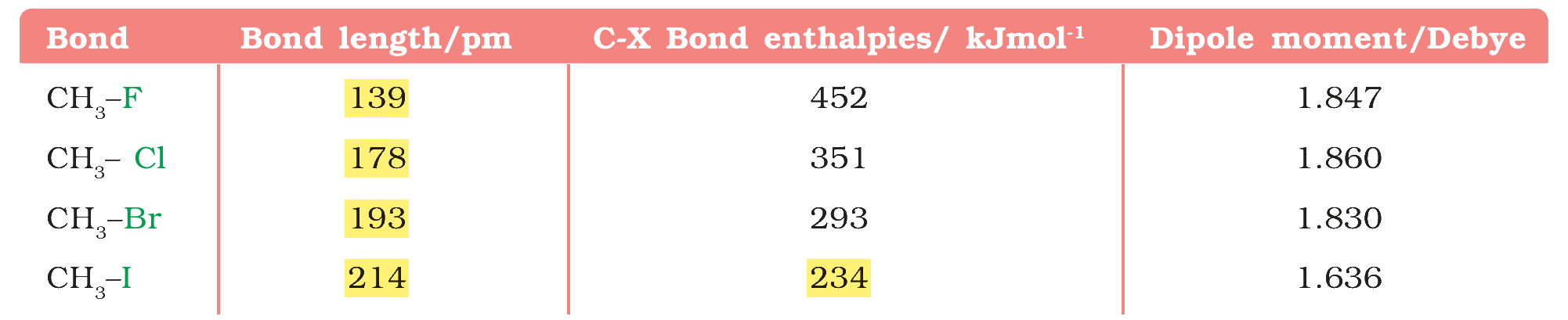
Statement I: As the size of the halogen atom increases from fluorine to iodine, the carbon–halogen bond length increases from C–F to C–I. — True. The bond lengths in the methyl halides rise from 139 pm (C–F) to 214 pm (C–I).
Statement II: Among the carbon–halogen bonds, the C–I bond has the highest bond enthalpy. — False. The longest bond, C–I, has the lowest bond enthalpy (234 kJ mol−1). The highest is that of the C–F bond (452 kJ mol−1).
NCERT (2026-27 edition):
6.3 Nature of C-X Bond – “As we go down the group in the periodic table, the size of halogen atom increases. Fluorine atom is the smallest and iodine atom is the largest. Consequently the carbon-halogen bond length also increases from C—F to C—I. Some typical bond lengths, bond enthalpies and dipole moments are given in Table 6.2.”
Table 6.2: Carbon-Halogen (C—X) Bond Lengths, Bond Enthalpies and Dipole Moments