Read the following passage and answer the following questions.
India's new beginning in the post-Cold War period is largely attributed to the liberal economic order. The liberal security order on the other hand has welcomed India's rise, unlike China, largely because India's democratic credentials gel well with the liberal principles. President Clinton made a state visit to India within two years of imposed sanctions against India's nuclear testing. The era witnessed reconciliation between the world’s oldest and largest democracies. The multi-sector cooperation alongside the Indo-US nuclear deal are some of the momentous diplomatic developments of the last decade. The Bush administration perceived a strong democratic India as an important partner for the United States and encouraged India to play an increasingly important leadership role in 21st century Asia. The inclusion of India in decision-making on matters of global governance, upgraded representation in trade and investment forums, admission into multilateral export control regimes (MTCR) and support for admission in Nuclear Suppliers Group (NSG) are indicative of growing partnership and strengthening of friendly relations between the US and India.
In which year did India declare itself a nuclear power state?
Answer & explanation
Correct answer: option 3
The correct answer is Option (3) → 1998
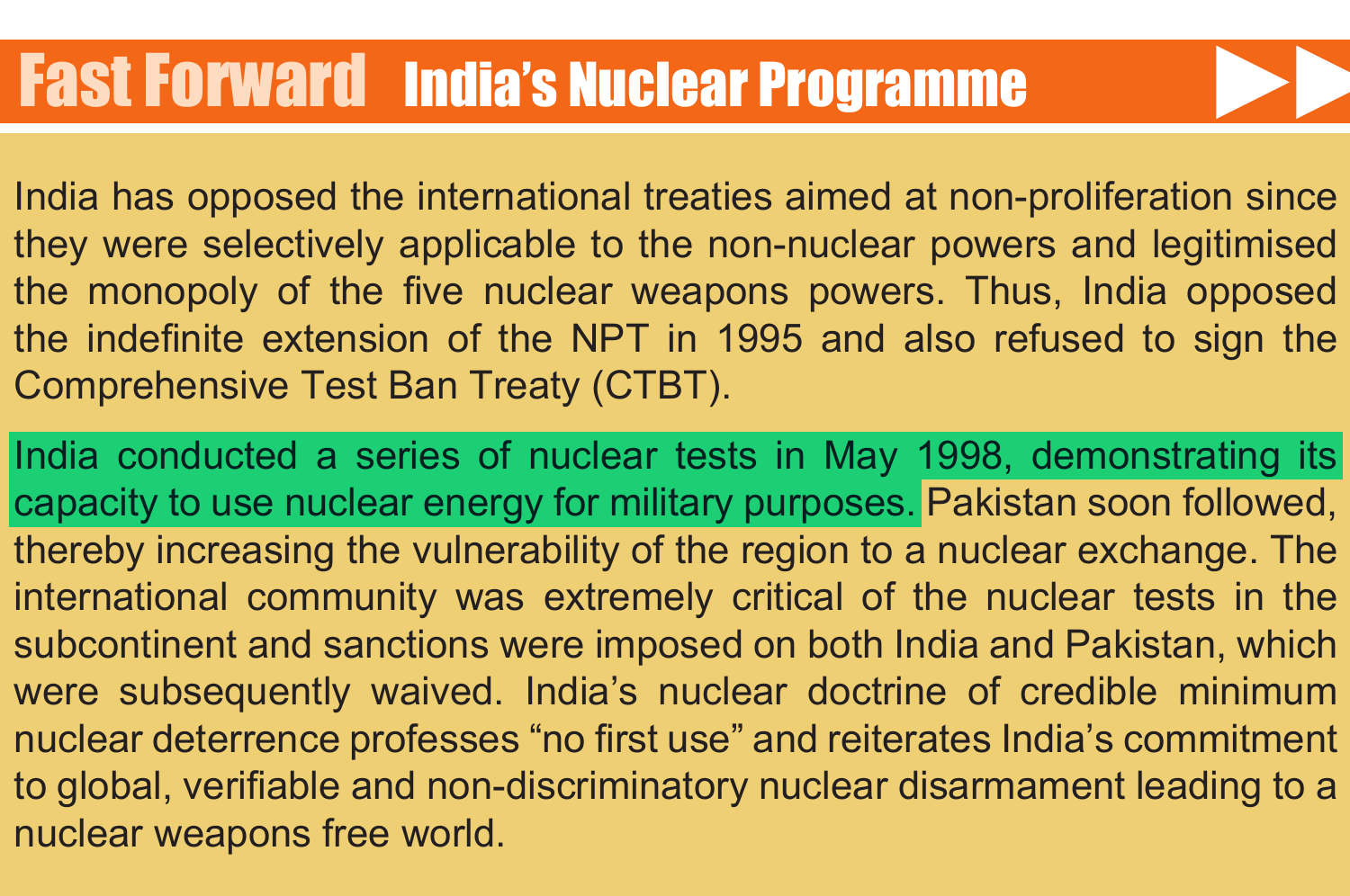
India conducted a series of nuclear tests in May 1998, demonstrating its capacity to use nuclear energy for military purposes.
Note: A same/similar question was asked in CUET (UG) in the papers below.
| 2026 | 2025 | 2024 | 2023 | 2022 |
| – | – | – | 31-05 S1* 06-06 S3 10-06 S3* | – |
* A similar question.
NCERT (2026-27): Politics in India since Independence — Chapter 4: India’s External Relations
Fast Forward box ‘India’s Nuclear Programme’ (2026-27): India conducted a series of nuclear tests in May 1998 |