
CUETMOCK
  • Pricing
  • Mentors
Log inStart freeStart free mocks→

First test, then trust

Try a free CUET mock test.

Join 5,00,000+ students who rehearsed exam day on the exact NTA screen before sitting CUET. On the web and on Android.

Start free mocks →Get the Android app
CUETMOCK

India's #1 CUET Mock Test Platform. Original NCERT-based questions on the exact NTA exam screen — trusted by 5,00,000+ students since CUET 2022.

Get it onGoogle PlayScan to download the CUETMOCK app

Mock tests

  • CUET mock test series
  • Commerce mocks
  • Humanities (Arts) mocks
  • Science mocks
  • Languages & GAT mocks
  • Free practice questions
  • Pricing

Resources

  • CUET exam guide
  • CUET syllabus
  • Universities accepting CUET
  • Expert blogs
  • News & notifications
  • Webinars & counselling
  • CUET score calculator
  • How we estimate your rank
  • FAQs

Company

  • About us
  • Our leadership & team
  • Our toppers
  • Mentors
  • For schools
  • Contact us
  • Terms
  • Privacy
  • Refund policy

Talk to us

+91 7696 6630 56info@cuetmock.comWhatsApp us

Our other platforms

  • JEE Mock — For IIT-JEE aspirants
  • NEET Mock — For NEET aspirants

Newsletter

Exam updates, study material and offers — no spam.

© 2026 NYC Ventures Pvt. Ltd.

701-702, Royal Business Park, Zirakpur, Punjab - 140603

  • Terms of use
  • Privacy policy
  • Refund policy
  • Contact us

iCUETMOCK is an independent preparation platform, not affiliated with the National Testing Agency (NTA). Always check exam details on the official NTA website.

  • Home
  • Mock tests
  • CUET guide
  • Pricing
  • Log in
Home/Practice questions/Biology
BiologyBiotechnology -Principles and Processes

Which of the following statements about the polymerase chain reaction…

Which of the following statements about the polymerase chain reaction (PCR) is incorrect?

Answer & explanation+

Correct answer: option 4

The correct answer is Option (4) → Each cycle of PCR has three steps: denaturation, primer annealing and ligation.

The polymerase chain reaction (PCR) makes many copies of a gene or piece of DNA in vitro. Each cycle has three steps: denaturation (heat separates the two DNA strands), primer annealing (primers bind to the single strands) and extension of primers (DNA polymerase lengthens the primers using the nucleotides supplied).

Option (1) In PCR, multiple copies of the gene (or DNA) of interest are synthesised in vitro. — A correct statement. PCR copies the gene or DNA of interest outside the cell (in vitro), in a tube.

Option (2) PCR uses two sets of primers and the enzyme DNA polymerase. — A correct statement. PCR needs two sets of primers and the enzyme DNA polymerase (a thermostable one, from Thermus aquaticus).

Option (3) The primers are small, chemically synthesised oligonucleotides complementary to regions of the DNA. — A correct statement. Primers are small, chemically made oligonucleotides. They match the two ends of the region to be copied.

Option (4) Each cycle of PCR has three steps: denaturation, primer annealing and ligation. — An incorrect statement. The third step is extension of primers by DNA polymerase, not ligation. Ligation means joining DNA pieces with DNA ligase, which plays no part in a PCR cycle.

NCERT Extract:
Amplification of Gene of Interest Using PCR – “PCR stands for Polymerase Chain Reaction. In this reaction, multiple copies of the gene (or DNA) of interest is synthesised in vitro using two sets of primers (small chemically synthesised oligonucleotides that are complementary to the regions of DNA) and the enzyme DNA polymerase. The enzyme extends the primers using the nucleotides provided in the reaction and the genomic DNA as template.”
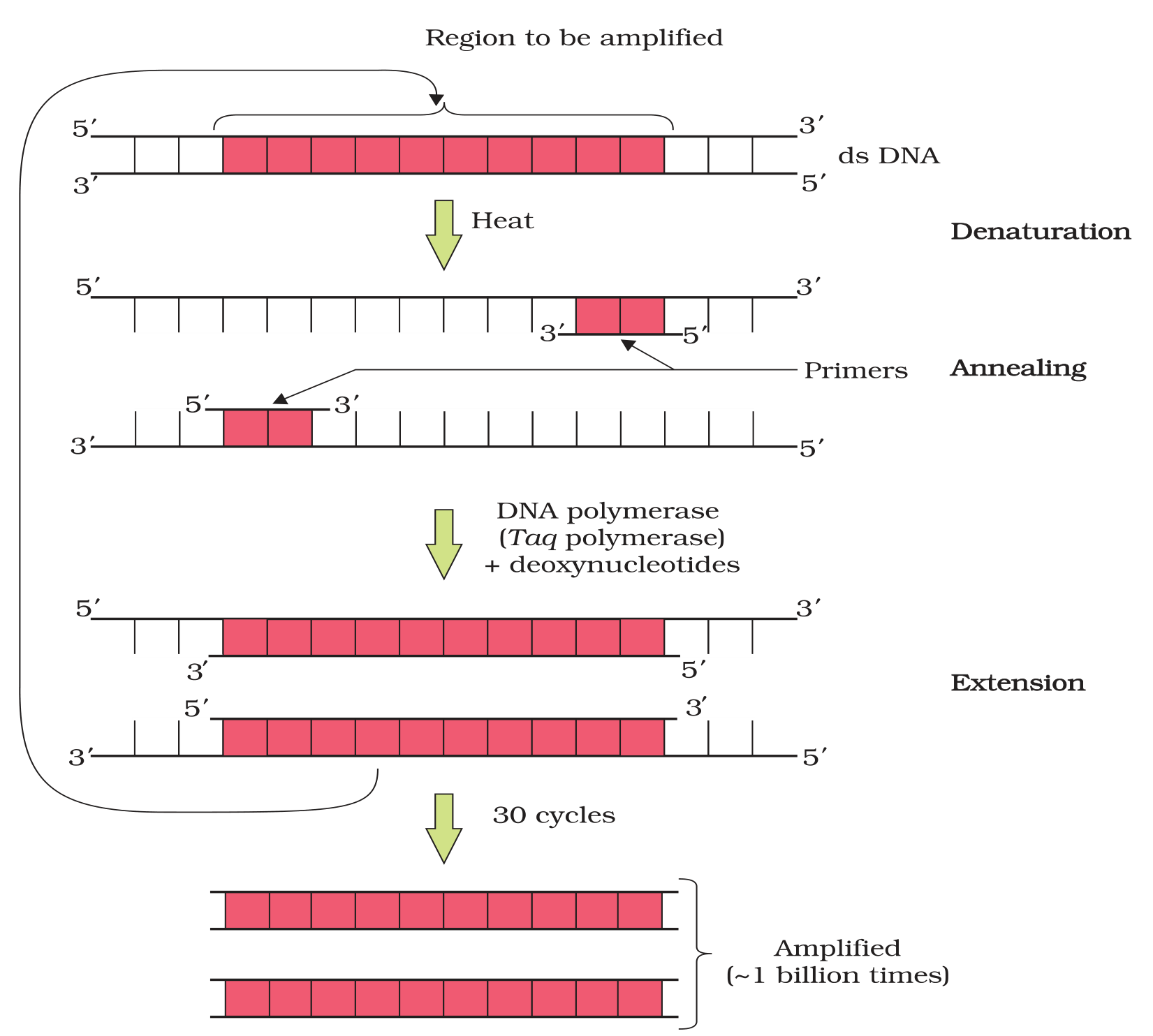
Textbook figure

Figure 9.6 Polymerase chain reaction (PCR): Each cycle has three steps: (i) Denaturation; (ii) Primer annealing; and (iii) Extension of primers

Advertisement

Practise more on Biotechnology -Principles and Processes

Chapter-wise mocks on the real NTA exam screen, with solutions and your rank. Your first mocks are free.

Start free mocks →

Advertisement

Next questions

  1. During denaturation of proteinsChemistry · Organic: Biomolecules
  2. Which Sikh Guru is also known as Hind-dee-Chadar ?General Aptitude Test · General Knowledge
  3. Match List - I with List - II. List – I List – II (A) Producer → Consumer (I) One level (B) Producer → Retailer → Consumer (II) Three level…Entrepreneurship · Entrepreneurial Opportunity
  4. Two lines have been left out between the third and the fourth sentences of the passage. The first of them tells how peasants held their lan…History · Medieval India: Peasants, Zamindars and the State
  5. What is the name of the artwork shown above?Fine Arts · The Pahari Schools of Painting
  6. A transistor is preferred to a triode valve. Which of the following is correct explanation?Physics · Semiconductors and Electronic Devices
  7. From which year was A.K. Gopalan a Member of Parliament?Political Science · Politics in India Since Independence: Era of one Party Dominance
  8. 50 g of ethylene glycol ( C_2H_6O_2 ) is mixed with 900 g of water. The freezing point of the solution will be ( K_f of water = 1.86 K kg m…Chemistry · Physical: Solutions
  9. Which of the following towns was grown as a temple town during the Chola dynasty?General Aptitude Test · General Knowledge
  10. A shy client first watches the therapist greet strangers confidently. He is then praised for each small change as he begins to behave the s…Psychology · Therapeutic Approaches