
CUETMOCK
  • Pricing
  • Mentors
Log inStart freeStart free mocks→

First test, then trust

Try a free CUET mock test.

Join 5,00,000+ students who rehearsed exam day on the exact NTA screen before sitting CUET. On the web and on Android.

Start free mocks →Get the Android app
CUETMOCK

India's #1 CUET Mock Test Platform. Original NCERT-based questions on the exact NTA exam screen — trusted by 5,00,000+ students since CUET 2022.

Get it onGoogle PlayScan to download the CUETMOCK app

Mock tests

  • CUET mock test series
  • Commerce mocks
  • Humanities (Arts) mocks
  • Science mocks
  • Languages & GAT mocks
  • Free practice questions
  • Pricing

Resources

  • CUET exam guide
  • CUET syllabus
  • Universities accepting CUET
  • Expert blogs
  • News & notifications
  • Webinars & counselling
  • CUET score calculator
  • How we estimate your rank
  • FAQs

Company

  • About us
  • Our leadership & team
  • Our toppers
  • Mentors
  • For schools
  • Contact us
  • Terms
  • Privacy
  • Refund policy

Talk to us

+91 7696 6630 56info@cuetmock.comWhatsApp us

Our other platforms

  • JEE Mock — For IIT-JEE aspirants
  • NEET Mock — For NEET aspirants

Newsletter

Exam updates, study material and offers — no spam.

© 2026 NYC Ventures Pvt. Ltd.

701-702, Royal Business Park, Zirakpur, Punjab - 140603

  • Terms of use
  • Privacy policy
  • Refund policy
  • Contact us

iCUETMOCK is an independent preparation platform, not affiliated with the National Testing Agency (NTA). Always check exam details on the official NTA website.

  • Home
  • Mock tests
  • CUET guide
  • Pricing
  • Log in
Home/Practice questions/Chemistry
ChemistryInorganic: D and F Block Elements

Transition metals show highest oxidation state in its....

Properties of transition metals

In general, the electronic configuration of outer orbitals of transition elements is (n-1)d1– 10 ns1–2. However, the electronic configurations of outer orbitals of Zn, Cd, Hg, and Cn are represented by the general formula (n-1)d1– 10 ns2. These metals are very hard and have low volatility due to high enthalpy of atomization. The more unpaired electrons, the higher the enthalpy of atomization. The stability of the half-filled d subshell in Mn2+ and the completely filled d10 configuration in Zn2+ are related to their E° values, whereas E° for Ni is related to the highest negative ΔhydH°.

Transition metals show highest oxidation state in its....

Answer & explanation+

Correct answer: option 3

The correct answer is Option (3) → oxide

A metal can show a high oxidation state only with an element that is small and highly electronegative, so that it can remove many electrons from the metal. Oxygen and fluorine are the two such elements. Oxygen goes further than fluorine because it can form multiple (double) bonds with the metal, so one oxygen atom can take up two of the metal’s valencies.

Examples from the 3d series:

  • Manganese: \( \ce{Mn2O7} \) and \( \ce{MnO4^{-}} \) (+7), while its highest fluoride is only \( \ce{MnF4} \) (+4).

  • Chromium: \( \ce{CrO3} \) and \( \ce{Cr2O7^{2-}} \) (+6).

  • Vanadium: \( \ce{V2O5} \) (+5).

So transition metals show their highest oxidation state in their oxides (and oxoanions).

Why the other options are incorrect

  • Option (1) nitrate — Incorrect. Nitrate is a large ion with a single negative charge and cannot stabilise a very high oxidation state; metal nitrates show common, lower oxidation states such as +2 and +3.

  • Option (2) acetate — Incorrect. Acetate is also a bulky, singly charged ion, and the metal in acetates is usually in a low oxidation state.

  • Option (4) chloride — Incorrect. Chlorine is larger and less electronegative than oxygen and fluorine, so chlorides do not reach the highest oxidation states.

Note: It seems that there is a mistake in the original NTA paper, which prints the outer electronic configuration of Zn, Cd, Hg and Cn as (n−1)d1–10ns2 when it should read (n−1)d10ns2, because these metals have a completely filled d subshell. The next sentence, “These metals are very hard and have low volatility due to high enthalpy of atomization”, reads as if it describes Zn, Cd and Hg, but it is true of transition metals in general. Zn, Cd and Hg are soft and fairly volatile (mercury is a liquid) and have the lowest enthalpies of atomisation, because they have no unpaired d electrons for metallic bonding.

NCERT (2026-27 edition):
Trends in Stability of Higher Oxidation States – …
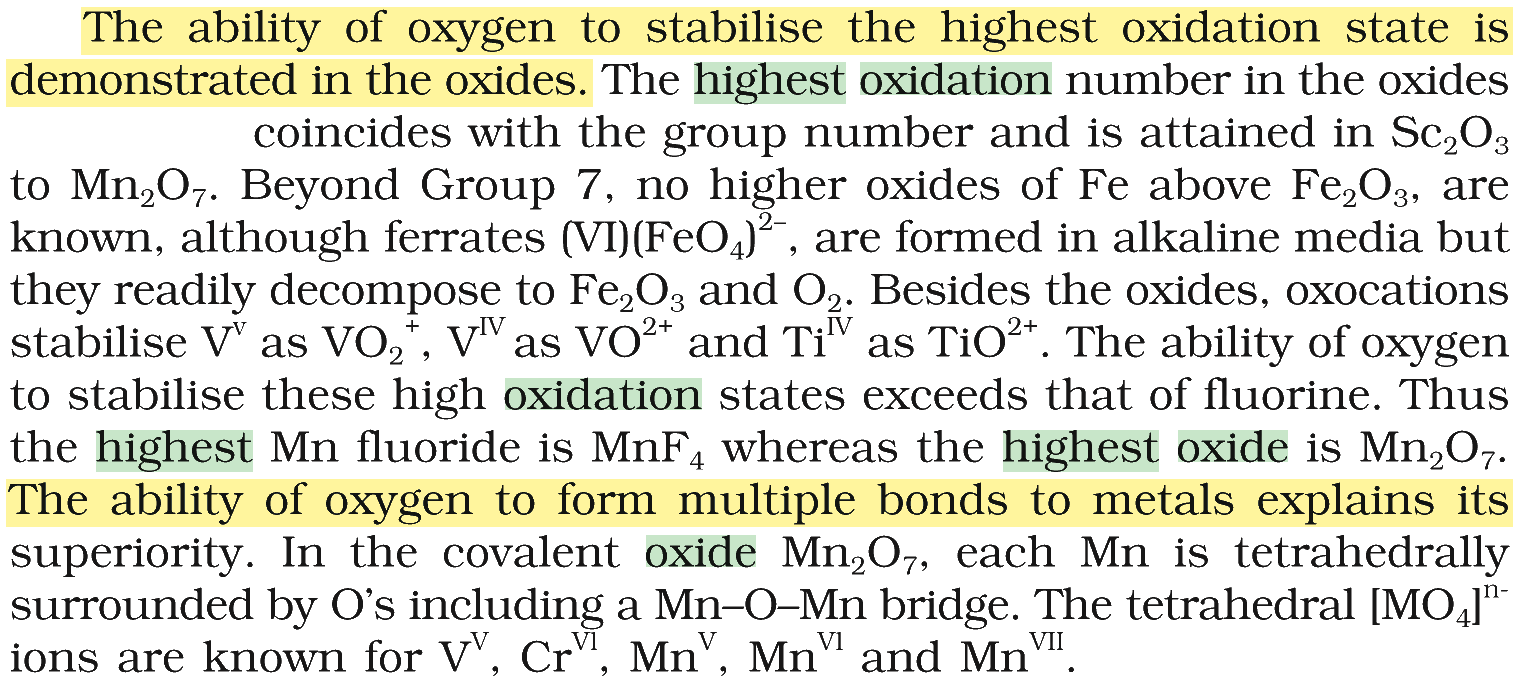
Textbook extract

Advertisement

Practise more on Inorganic: D and F Block Elements

Chapter-wise mocks on the real NTA exam screen, with solutions and your rank. Your first mocks are free.

Start free mocks →

Advertisement

Next questions

  1. A nitrogenous base is linked to the 'OH' of 1' C pentose sugar through:Biology · Molecular Basis of Inheritance
  2. Which of the following transaction will increase Current Ratio but will decrease Debt Equity Ratio?Accountancy Part B · Accounting Ratios
  3. In case a company issued shares of face value Rs 100 in consideration of a building purchased for Rs 10,80,000, at the following issue pric…Accountancy Part A · Accounting for Shares
  4. Arrange the following shifts in Nike’s shoe production in the correct chronological sequence:(A) Production started in Japan.(B) Production…Sociology · Social Change and Development in India: Globalisation and Social Change
  5. Self-actualization means:Psychology · Self and Personality
  6. Common Size Statement are also known as:Accountancy Part B · Analysis of Financial Statements
  7. Which of the following is not an importance of Decentralization?Business Studies · Organising
  8. The symptoms of AIDS are usually expressed after:Biology · Human Health and Disease
  9. If A and B are two independent events, then which of the following statements are TRUE ?(A) P(A∪B)=P(A)+P(B)-P(A).P(B) (B) P(A∪B)=P(A)+P(B)…Maths. Section B1 · Probability
  10. Let f:≤ft(-(π)/2,(π)/2)→R be a function such that f(x)=cos[x] , where [.] is greatest integer function then range (f(x)) isMaths. Section B1 · Relations and Functions