
Which of the following statements are incorrect?
(A) The root tip is covered with a root cap.
(B) A typical dicotyledonous embryo consists of an embryonal axis and two cotyledons.
(C) The portion of embryonal axis above the level of cotyledons is the hypocotyl, which terminates with the plumule or stem tip.
(D) In the grass family the cotyledon is called scutellum that is situated towards both sides of the embryonal axis.
Answer & explanation
Correct answer: option 4
The correct answer is Option (4) → C and D only
A dicot embryo has an embryonal axis and two cotyledons. The cotyledons divide the axis into two parts: the epicotyl above them and the hypocotyl below them. A grass embryo has a single cotyledon, the scutellum.
(A) The root tip is covered with a root cap. — True. The lower end of the axis ends in the radicle or root tip, and a root cap covers it.
(B) A typical dicotyledonous embryo consists of an embryonal axis and two cotyledons. — True. This is the basic plan of a dicot embryo, as in pea and bean.
(C) The portion of embryonal axis above the level of cotyledons is the hypocotyl, which terminates with the plumule or stem tip. — False. The part above the cotyledons, ending in the plumule, is the epicotyl. The hypocotyl lies below the cotyledons and ends in the radicle.
(D) In the grass family the cotyledon is called scutellum that is situated towards both sides of the embryonal axis. — False. The scutellum lies on one side (lateral) of the embryonal axis, not on both sides.
NCERT Extract:
Embryo – “… A typical dicotyledonous embryo (Figure 1.14a), consists of an embryonal axis and two cotyledons. The portion of embryonal axis above the level of cotyledons is the epicotyl, which terminates with the plumule or stem tip. The cylindrical portion below the level of cotyledons is hypocotyl that terminates at its lower end in the radicle or root tip. The root tip is covered with a root cap. Embryos of monocotyledons (Figure 1.14 b) possess only one cotyledon. In the grass family the cotyledon is called scutellum that is situated towards one side (lateral) of the embryonal axis.”
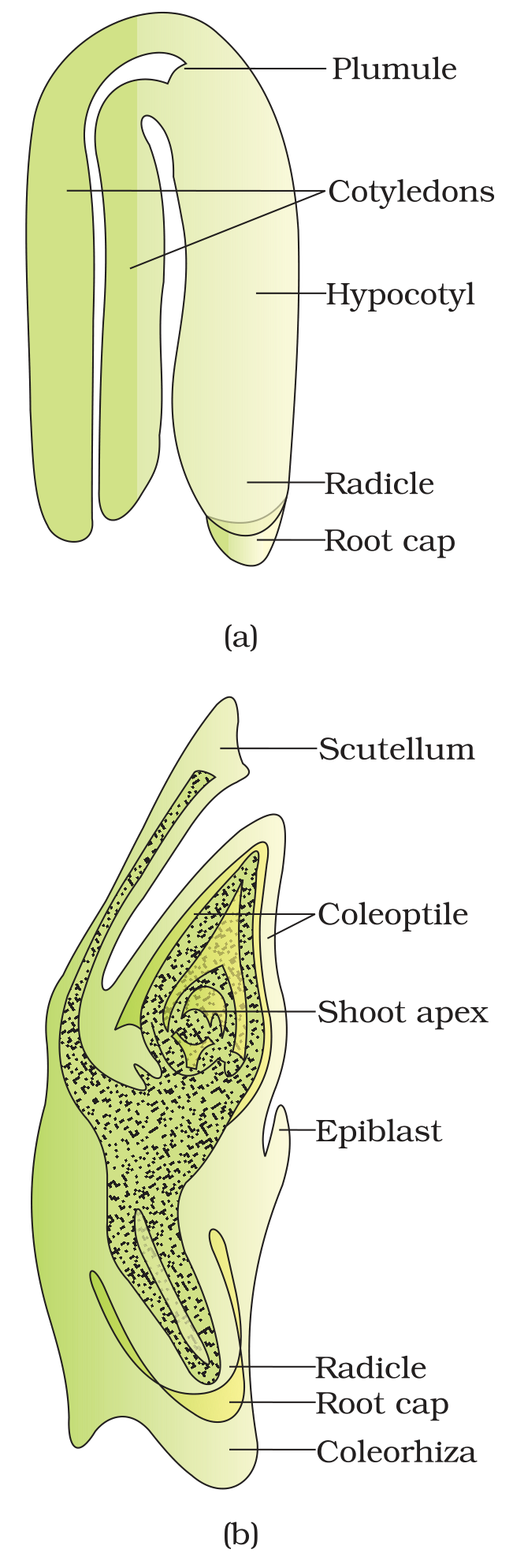
Figure 1.14 (a) A typical dicot embryo; (b) L.S. of an embryo of grass