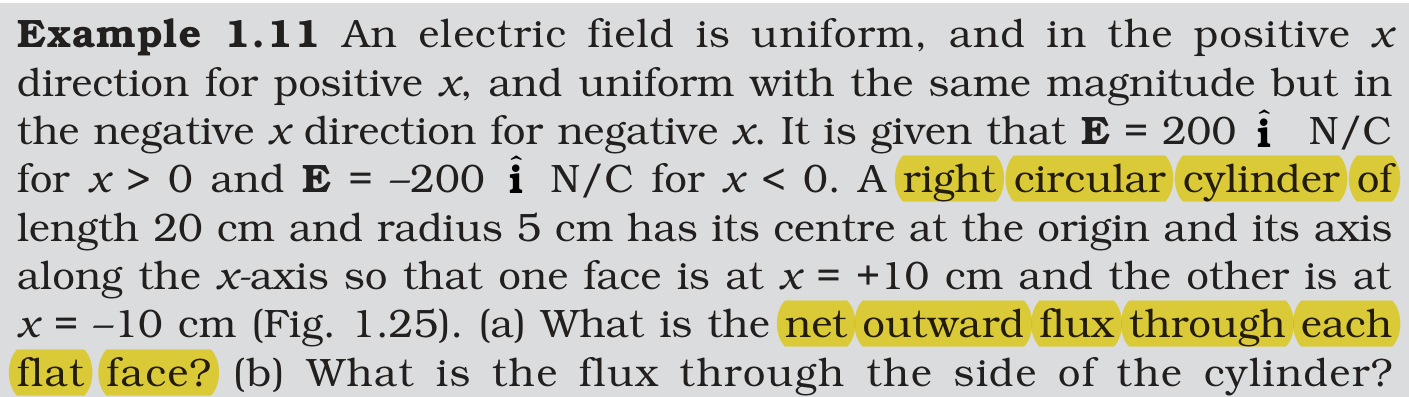
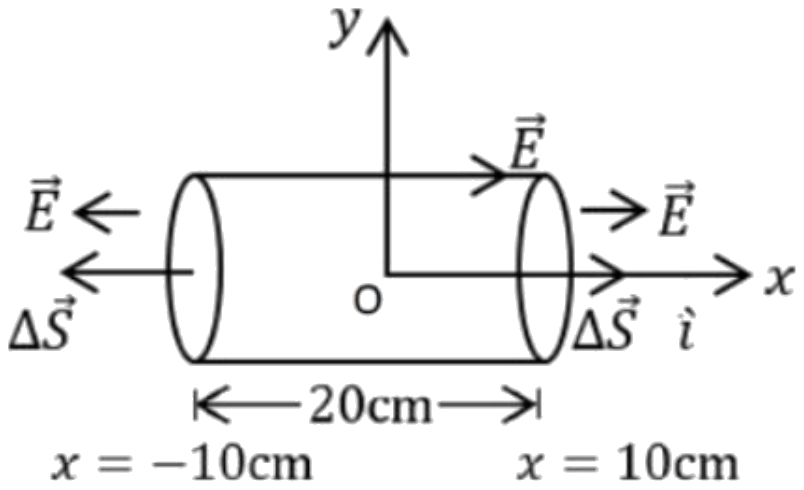
A uniform electric field is given by \( \vec{E} = +200\hat{\imath}\ \mathrm{N/C} \) for \( x \gt 0 \) and \( \vec{E} = -200\hat{\imath}\ \mathrm{N/C} \) for \( x \lt 0 \). A right circular cylinder of length \( 20\ \mathrm{cm} \) and area of cross-section \( 10\ \mathrm{cm^{2}} \) has its centre at the origin and its axis along the \( x \)-axis so that one face is at \( x = +10\ \mathrm{cm} \) and the other is at \( x = -10\ \mathrm{cm} \) as shown in the figure. The fluxes through the flat faces at \( x = -10\ \mathrm{cm} \) and \( x = +10\ \mathrm{cm} \), respectively, are __________ (in SI-units).
Answer & explanation
Correct answer: option 4
The correct answer is Option (4) → \( +0.2,\ +0.2 \)
The flux through a flat face is \( \phi = \vec{E}\cdot\Delta\vec{S} \), where the area vector of a face of a closed surface points along the outward normal.
\( \Delta S = 10\,\mathrm{cm^{2}} = 10\times10^{-4}\,\mathrm{m^{2}} = 10^{-3}\,\mathrm{m^{2}} \)
Face at \( x = -10 \) cm: the outward normal is \( -\hat{\imath} \) and the field there is \( -200\hat{\imath} \) N/C.
\( \phi_{L} = (-200\hat{\imath})\cdot(-10^{-3}\hat{\imath}) = +0.2\,\mathrm{N\,m^{2}\,C^{-1}} \)
Face at \( x = +10 \) cm: the outward normal is \( +\hat{\imath} \) and the field there is \( +200\hat{\imath} \) N/C.
\( \phi_{R} = (200\hat{\imath})\cdot(10^{-3}\hat{\imath}) = +0.2\,\mathrm{N\,m^{2}\,C^{-1}} \)
On both faces the field points outwards, so both fluxes are positive: \( +0.2 \) and \( +0.2 \).
Note: NTA picked this question from an NCERT (2026-27) example and changed the figures. Do not ignore NCERT while practising numericals.
NCERT (2026-27):
Gauss’s Law – …