Read the passage and answer the following question.
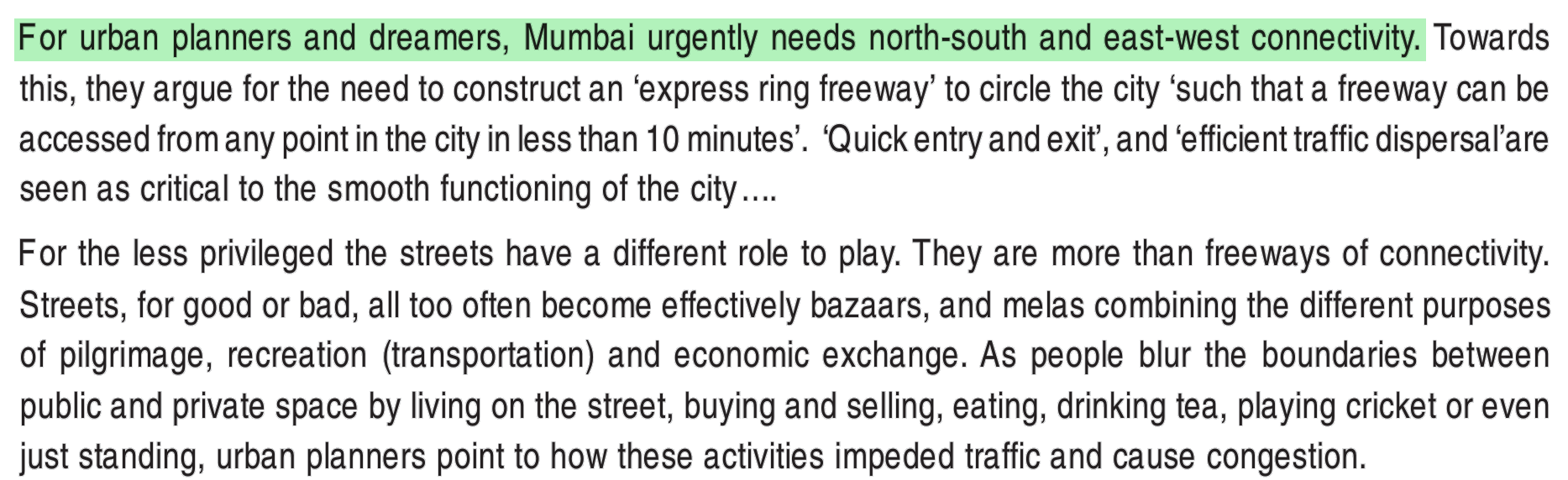
Recent years have seen a great focus on making Indian cities global cities. For urban planners and dreamers, Mumbai urgently needs north-south and east-west connectivity. Towards this, they argue for the need to construct an 'express ring freeway' to circle the city' such that a freeway can be accessed from any point in the city in less than 10 minutes'. 'Quick entry and exit', and 'efficient traffic dispersal' are seen as critical to the smooth functioning of the city....
For the less privileged the streets have a different role to play. They are more than freeways of connectivity. Streets, for good or bad, all too often become effectively bazaars, and melas combining the different purposes of pilgrimage, recreation (transportation) and economic exchange. As people blur the boundaries between public and private space by living on the street, buying and selling, eating, drinking tea, playing cricket or even just standing, urban planners point to how these activities impeded traffic and cause congestion.
In order to decongest, poor people are shifted to the outskirts. In the Vision Mumbai document prepared by the private consultancy from McKinsey...mass housing for the poor is being planned in the salt pan lands outside the city. What happens to their livelihood? The long quote below captures the voice of the poor.
"We are in fact human earthmovers and tractors. We levelled the land first. We have contributed to the city. We carry your shit out of the city. I don't see citizens' groups dredging sewers and digging roads. The city is not for the rich only. We need each other. I don't beg. I wash your clothes. Women can go to work because we are there to look after their children. The staff in Mantralay, the collectorate, the BMC, even the police live in slums. Because we are there, women can walk safely at night...Groups such as Bombay First talk about Mumbai a world class city. How can it be a world-class city without a place for its poor?
In the above case study urban planners and dreamers would fall into the category of:
Answer & explanation
Correct answer: option 1
The correct answer is Option (1) → Municipal corporations
Option (1) Municipal corporations — Correct. The urban planners of the passage plan the roads and traffic of a whole city, the ‘express ring freeway’ and quick entry and exit. Of the four options, municipal corporations are the only bodies that govern a city: they are the elected local self-government bodies of the municipal (urban) areas, which the 73rd and 74th Amendments made compulsory to elect every five years. City planning belongs to this urban local government.
Option (2) Nyaya Panchayats — Incorrect. Nyaya Panchayats are village courts. They hear petty civil and criminal cases and can impose fines, but they do not plan roads or cities.
Option (3) Khaap Panchayats — Incorrect. Khap panchayats are caste panchayats of villages that set themselves up as guardians of village morality, for example by ordering couples of the same gotra to dissolve their marriage. They are not elected bodies and have nothing to do with planning a city.
Option (4) Block Development offices — Incorrect. A Block Development Office is the government office that runs rural development programmes for a group of villages, called a block. It serves rural areas, not the roads and traffic of a big city like Mumbai.
Note 1: The passage and the Khap panchayat box (‘Bound by Honour’) belong to the chapter ‘The Story of Indian Democracy’ of the pre-rationalised NCERT, which NTA followed in 2023. The chapter has been renamed ‘The Constitution and Social Change’ in the NCERT book (2025-26), and both boxes have been deleted, though its section on local bodies in rural and municipal areas is still there.
Note 2: This is an application-based question. The passage does not name the body to which the urban planners belong. The book explains local bodies of the municipal (urban) areas; applying this to planners who design a city’s roads and traffic gives municipal corporations, the only urban governing body among the four options.
NCERT (2025-26): “Ideals of Panchayati Raj … It was, however, only in 1992 that grassroot democracy or decentralised governance was ushered in by the 73rd Constitutional Amendment. This act provided constitutional status to the Panchayati Raj Institutions (PRIs). It is compulsory now for local self-government bodies in rural and municipal areas to be elected every five years. More importantly, control of local resources is given to the elected local bodies.…” “…Nyaya Panchayats have been constituted in some states. They possess the authority to hear some petty, civil and criminal cases. They can impose fines but cannot award a sentence.…”
Box 3.16, The Story of Indian Democracy (Pre-rationalised NCERT) |