
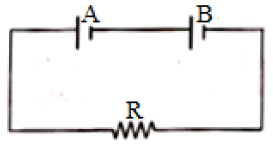
Two batteries A and B, each of emf 2 V, are connected in series to an external resistance \( R=1\,\Omega \). The internal resistance of battery A is \( 1.9\,\Omega \) and that of B is \( 0.9\,\Omega \). What is the potential difference between the terminals of battery A?
Answer & explanation
Correct answer: option 3
The correct answer is Option (3) → Zero
The potential difference between the terminals of a cell that delivers a current \( I \) is its emf minus the drop across its internal resistance, \( V=\varepsilon-Ir \). From the figure, A and B are joined in series in the same sense, so their emfs add. The same current flows through R, A and B.
The current in the circuit is:
\( \begin{aligned} I &= \frac{\varepsilon_A+\varepsilon_B}{R+r_A+r_B} \\ &= \frac{2\,\mathrm{V}+2\,\mathrm{V}}{(1+1.9+0.9)\,\Omega} \\ &= \frac{4}{3.8}\,\mathrm{A} \end{aligned} \)
The terminal potential difference of A is:
\( \begin{aligned} V_A &= \varepsilon_A-Ir_A \\ &= 2\,\mathrm{V}-\frac{4}{3.8}\,\mathrm{A}\times1.9\,\Omega \\ &= 2\,\mathrm{V}-2\,\mathrm{V} \\ &= 0 \end{aligned} \)
Therefore, the drop across the internal resistance of A equals its emf, and no potential difference is left between its terminals.