
Which of the following are components of a bioreactor?
I. Agitator system
II. Oxygen delivery system
III. Foam control system
IV. Temperature control system
V. pH control system
VI. Sampling ports to withdraw cultures periodically
Choose the correct option.
Answer & explanation
Correct answer: option 4
The correct answer is Option (4) → I, II, III, IV, V and VI
A bioreactor is a large vessel in which cells are grown to make a product on a large scale. It must give the cells the best conditions: the right temperature, pH, oxygen and mixing. The common stirred-tank bioreactor has a set of control systems for this.
I. Agitator system — True. The stirrer mixes the contents evenly and spreads oxygen through the culture.
II. Oxygen delivery system — True. Sterile air is supplied so that the cells get enough oxygen.
III. Foam control system — True. Stirring and bubbling make foam. A foam breaker keeps it down.
IV. Temperature control system — True. Cells grow best at an optimum temperature, which is kept steady.
V. pH control system — True. Acid or base is added to keep the pH at the best level.
VI. Sampling ports to withdraw cultures periodically — True. Small volumes of the culture are taken out from time to time to check its progress.
All six are parts of a bioreactor.
NCERT Extract:
Obtaining the Foreign Gene Product – “… A stirred-tank reactor is usually cylindrical or with a curved base to facilitate the mixing of the reactor contents. The stirrer facilitates even mixing and oxygen availability throughout the bioreactor. Alternatively air can be bubbled through the reactor. … the bioreactor has an agitator system, an oxygen delivery system and a foam control system, a temperature control system, pH control system and sampling ports so that small volumes of the culture can be withdrawn periodically.”
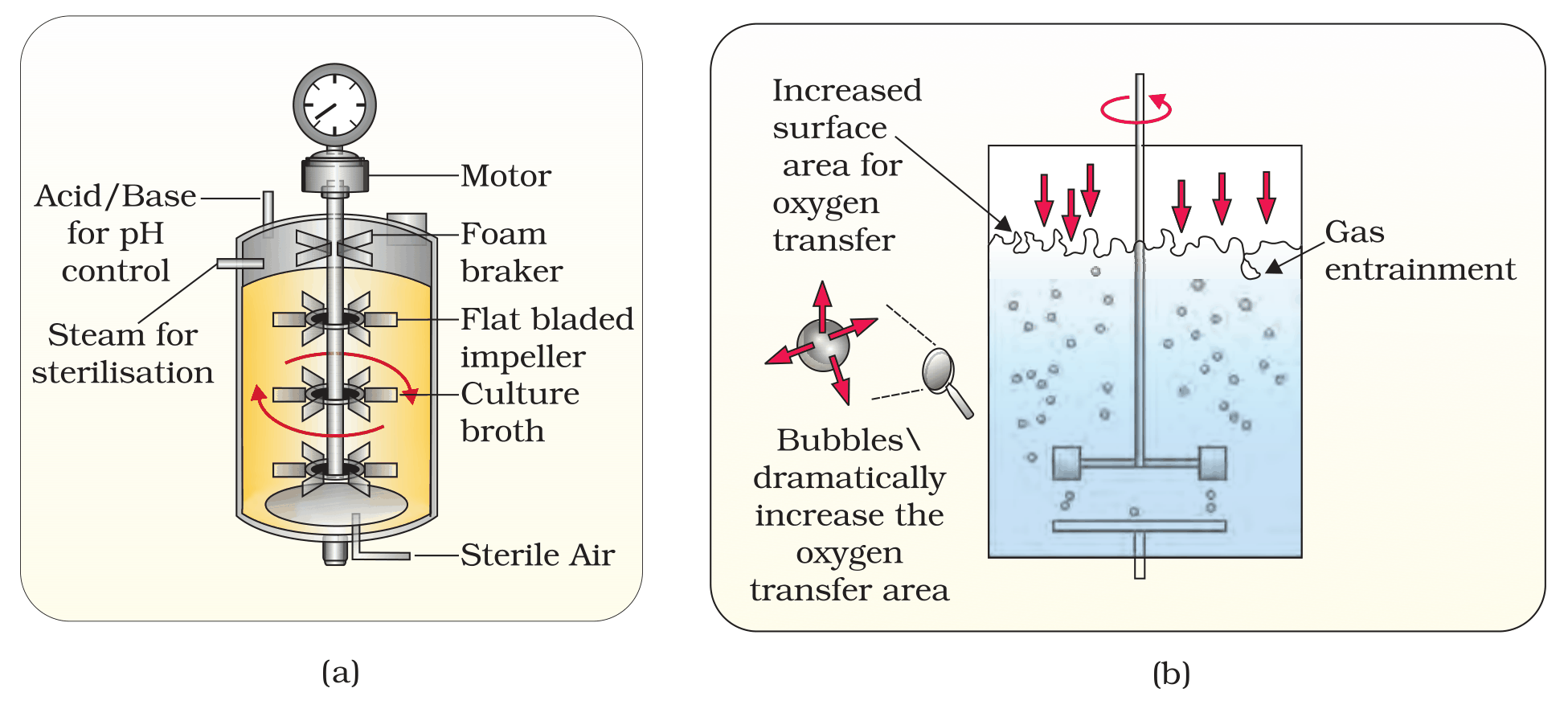
Figure 9.7 (a) Simple stirred-tank bioreactor; (b) Sparged stirred-tank bioreactor through which sterile air bubbles are sparged