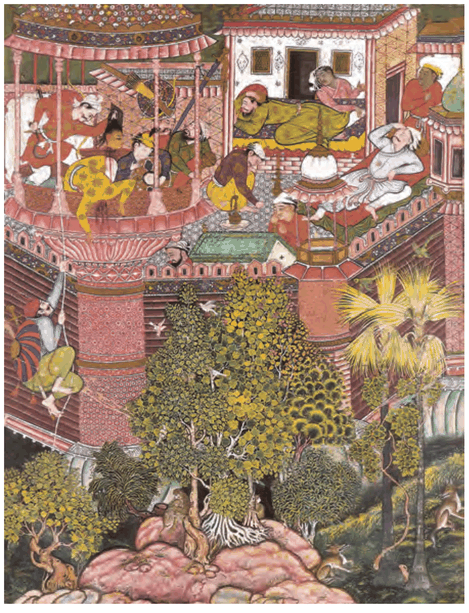
Spies Attack the City of Kaymar is a Hamza Nama folio. Match the features of this folio in List-I with their source or effect in List-II.
| List-I | List-II |
|---|---|
| A. The space, sharply cut and divided | I. Persian sources |
| B. Four-limbed animals and rocks | II. Visual reading of the narrative |
| C. Rich palette of pure yellows, reds and browns | III. Indian source |
| D. The vibrant colours | IV. Energising the unfolding of the story |
Choose the correct answer from the options given below:
Answer & explanation
Correct answer: option 3
The correct answer is Option (3) → A-II, B-I, C-III, D-IV
| List-I | List-II | Reason |
|---|---|---|
| (A) The space, sharply cut and divided | (II) Visual reading of the narrative | The space is sharply cut and divided so that the story can be read visually. |
| (B) Four-limbed animals and rocks | (I) Persian sources | The four-limbed animals and rocks come from Persian sources, as do the patterns on the floor, columns and canopy. |
| (C) Rich palette of pure yellows, reds and browns | (III) Indian source | This palette points to an Indian source, as do the trees and creepers. |
| (D) The vibrant colours | (IV) Energising the unfolding of the story | Much action happens in the scene. The vibrant colours energise the unfolding of the story of the spies’ attack. |
Note: This topic was not named in the CUET 2026 syllabus, but it was part of the NCERT chapter. In 2025 and 2026, NTA also asked questions on topics in NCERT that the CUET syllabus did not name. So our mocks have questions from every part of the NCERT chapter, to give you enough practice. Read the whole chapter, not only the sub-topics named in the syllabus.
NCERT (2026-27): “Early Mughal Painting …In Hamza Nama painting, Spies Attack the City of Kaymar (1567–82), the space is sharply cut and divided so as to facilitate visual reading of the narrative. Too much of action is happening and the vibrant colours are of great use here to energise the unfolding of this story, wherein, the spies of Hamza attack the city of Kaymar. …The rich intricate patterns on the floor, columns and canopy are from Persian sources as also the four-limbed animals and rocks. Trees and creepers indicate Indian source as also the rich palette of pure yellows, reds and browns.”
Spies of Hamza attack the City of Kaymar, 1567–1582, Museum of Applied Arts, Vienna |