
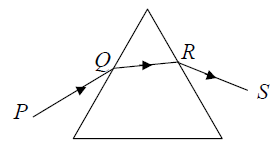
A ray of light is incident on an equilateral glass prism placed on a horizontal table. For minimum deviation, which of the following is true?
Answer & explanation
Correct answer: option 2
The correct answer is Option (2) → QR is horizontal
From the figure, PQ is the incident ray, QR the refracted ray inside the prism and RS the emergent ray. At minimum deviation the ray passes symmetrically through the prism, with \( i=e \) and \( r_1=r_2 \).
Option (1) PQ is horizontal — Incorrect. The ray bends towards the normal on entering the glass at Q. So PQ makes a larger angle with the normal than QR does (\( i\gt r_1 \)). With QR horizontal, PQ is tilted to it and cannot be horizontal.
Option (2) QR is horizontal — Correct. At minimum deviation the refracted ray inside the prism is parallel to its base. The prism rests on the horizontal table on its base, so QR is horizontal.
Option (3) RS is horizontal — Incorrect. The ray bends away from the normal on leaving the glass at R (\( e\gt r_2 \)), so RS is inclined to the horizontal ray QR.
Option (4) Either PQ or RS is horizontal — Incorrect. Both rays bend at the faces of the prism. Since \( i=e \), they tilt by equal amounts on the two sides. So neither of them is horizontal.
NCERT (2026-27):
Refraction Through a Prism – “… At the minimum deviation Dm, the refracted ray inside the prism becomes parallel to its base. We have δ = Dm, i = e which implies r1 = r2.”