
CUETMOCK
  • Pricing
  • Mentors
Log inStart freeStart free mocks→

First test, then trust

Try a free CUET mock test.

Join 5,00,000+ students who rehearsed exam day on the exact NTA screen before sitting CUET. On the web and on Android.

Start free mocks →Get the Android app
CUETMOCK

India's #1 CUET Mock Test Platform. Original NCERT-based questions on the exact NTA exam screen — trusted by 5,00,000+ students since CUET 2022.

Get it onGoogle PlayScan to download the CUETMOCK app

Mock tests

  • CUET mock test series
  • Browse all papers
  • Commerce mocks
  • Humanities (Arts) mocks
  • Science mocks
  • Languages & GAT mocks
  • Free practice questions
  • Pricing

Resources

  • CUET exam guide
  • CUET syllabus
  • Universities accepting CUET
  • Expert blogs
  • News & notifications
  • Webinars & counselling
  • CUET score calculator
  • How we estimate your rank
  • FAQs

Company

  • About us
  • Our leadership & team
  • Our toppers
  • Mentors
  • For schools
  • Contact us
  • Terms
  • Privacy
  • Refund policy

Talk to us

+91 7696 6630 56info@cuetmock.comWhatsApp us

Our other platforms

  • JEE Mock — For IIT-JEE aspirants
  • NEET Mock — For NEET aspirants

Newsletter

Exam updates, study material and offers — no spam.

© 2026 NYC Ventures Pvt. Ltd.

701-702, Royal Business Park, Zirakpur, Punjab - 140603

  • Terms of use
  • Privacy policy
  • Refund policy
  • Contact us

iCUETMOCK is an independent preparation platform, not affiliated with the National Testing Agency (NTA). Always check exam details on the official NTA website.

  • Home
  • Mock tests
  • CUET guide
  • Pricing
  • Log in
Home/Practice questions/Biology
BiologySexual Reproduction in Flowering Plants

Identify the diploid cells present in the ovule:(A) Outer integument(…

Answer the question from the diagram of typical anatropous ovule.
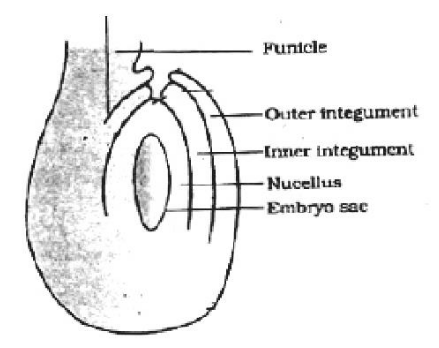
Anatropous ovule: funicle, outer and inner integuments, nucellus, embryo sac

Identify the diploid cells present in the ovule:

(A) Outer integument
(B) Antipodal
(C) Nucellus
(D) Synergids

Choose the correct answer from the options given below:

Answer & explanation+

Correct answer: option 2

The correct answer is Option (2) → (A), (C), only

(A) Outer integument — True. The integuments are part of the diploid ovule tissue.

(B) Antipodal — False. Antipodals are cells of the embryo sac, formed from the haploid megaspore.

(C) Nucellus — True. The nucellus is diploid tissue of the ovule.

(D) Synergids — False. Synergids belong to the haploid embryo sac.

Advertisement

Practise more on Sexual Reproduction in Flowering Plants

Chapter-wise mocks on the real NTA exam screen, with solutions and your rank. Your first mocks are free.

Start free mocks →

Advertisement

Next questions

  1. A stress management technique uses a sequence of learned steps for refocusing attention that brings about an altered state of consciousness…Psychology · Meeting Life Challenges
  2. Match the following work study technique. LIST I LIST II A) Motion Study I) Find out one best way of doing the job B) Method Study II) Elim…Business Studies · Principles of Management
  3. What can get polluted by point or non-point sources?English · Comprehension - (Narrative / Factual)
  4. 100J of work is done when 2μC of charge is moved in an electric field between two points. What is the potential difference between the two…Physics · Electrostatic Potential and Capacitance
  5. Which one is a tertiary activity?Geography · Fundamentals of Human Geography: Tertiary and Quaternary Activities
  6. Which of the following is correct?Legal Studies · Topics of Law
  7. Which of the following statements is incorrect?Political Science · Politics in India Since Independence: Recent Developments in Indian Politics
  8. Read the given statements and conclusions carefully. Assuming that the information given in the statements is true, even if it appears to b…General Aptitude Test · Verbal Reasoning
  9. A company offers four types of successive discount. Which offer is best for the customer?General Aptitude Test · Numerical Ability
  10. If matrix A = [a_ij]_2 × 2 where a_ij = […] , then A^3 is equal to :Applied Maths. Section B2 · Algebra