Carboxylic Acids: Types of Reactions
Carboxylic acid exhibits a number of reactions depending on the involvement of a specific part of the -COOH group. It mainly includes nucleophilic acyl substitution reaction, in which a hydroxy group of -COOH is replaced by another nucleophile, and the acidic behavior of carboxylic acids, which is due to the cleavage of O-H bond in -COOH group. The former reaction leads to the conversion of carboxylic acid into a variety of different derivatives/categories of organic compounds, whereas the latter converts it into salts which find applications in many industries, like soap and detergent synthesis and pharmaceutical industries. Other important types of chemical reactions involve reduction of -COOH group, decarboxylation, electrolysis and substitution reactions in the hydrocarbon part at α-carbon atom.
Which of the following reagent is most preferred for converting RCOOH into RCOCl ?
Answer & explanation
Correct answer: option 4
The correct answer is Option (4) → SOCl2
An acid chloride is made by replacing the –OH group of a carboxylic acid with –Cl. Three reagents can do this:
\( \displaystyle \ce{RCOOH + PCl5 -> RCOCl + POCl3 + HCl} \)
\( \displaystyle \ce{3RCOOH + PCl3 -> 3RCOCl + H3PO3} \)
\( \displaystyle \ce{RCOOH + SOCl2 -> RCOCl + SO2 ^ + HCl ^} \)
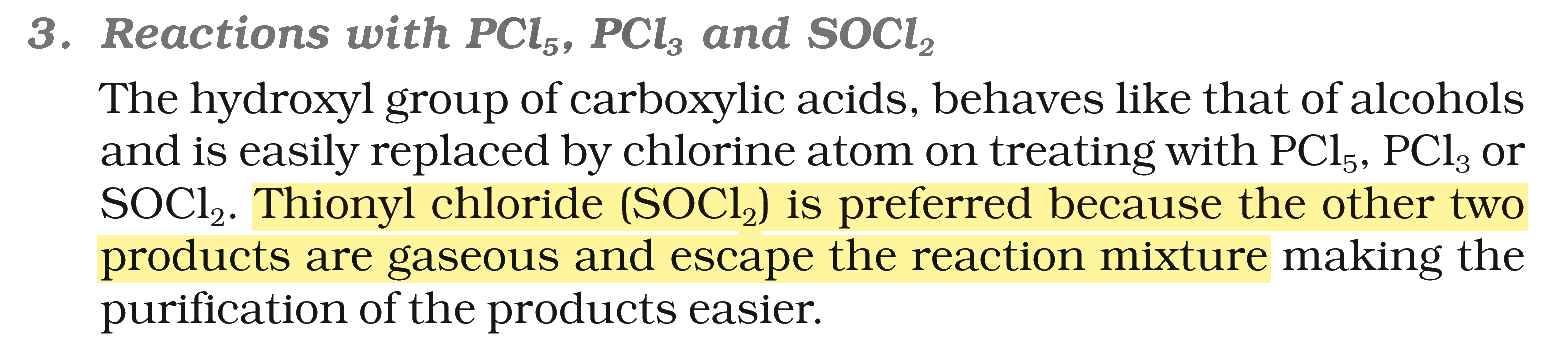
With thionyl chloride both by-products are gases, so SOCl2 is the most preferred reagent.
Why the other options are incorrect
Option (1) PCl5 — Incorrect. It does give RCOCl, but the by-product \( \ce{POCl3} \) is a liquid that must be separated by distillation.
Option (2) PCl3 — Incorrect. It also gives RCOCl, but the by-product \( \ce{H3PO3} \) stays in the mixture and must be separated.
Option (3) HCl — Incorrect. HCl cannot replace the –OH of a carboxylic acid. The C–OH bond is strengthened by resonance with the C=O group, so it is not broken the way it is in an alcohol.
NCERT (2026-27 edition):
Reactions with PCl5, PCl3 and SOCl2