
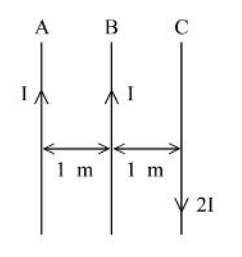
In the following figure A, B and C are parallel conductors carrying currents I, I and 2I respectively. Distance between A and B is 1 m and the distance between B and C is also 1 m. \( F_1 \) is the force exerted by B on A and \( F_2 \) is the force exerted by C on A. Choose the correct answer.
Answer & explanation
Correct answer: option 2
The correct answer is Option (2) → \( F_1 = -F_2 \)
The force per unit length between two long parallel conductors carrying currents \( I_a \) and \( I_b \) at a separation d is
\( \displaystyle f = \frac{\mu_0 I_aI_b}{2\pi d} \)
It is attractive for currents in the same direction and repulsive for currents in opposite directions. From the figure, A and B carry current upwards and C carries current downwards.
F1: force of B on A. The currents are parallel, so A is attracted towards B (to the right). The distance is 1 m.
\( \displaystyle F_1 = \frac{\mu_0 (I)(I)}{2\pi(1)} = \frac{\mu_0 I^{2}}{2\pi} \)
F2: force of C on A. The currents are opposite, so A is repelled away from C (to the left). The distance is 2 m.
\( \displaystyle F_2 = \frac{\mu_0 (I)(2I)}{2\pi(2)} = \frac{\mu_0 I^{2}}{2\pi} \)
The magnitudes are equal and the directions are opposite, so \( F_1 = -F_2 \).