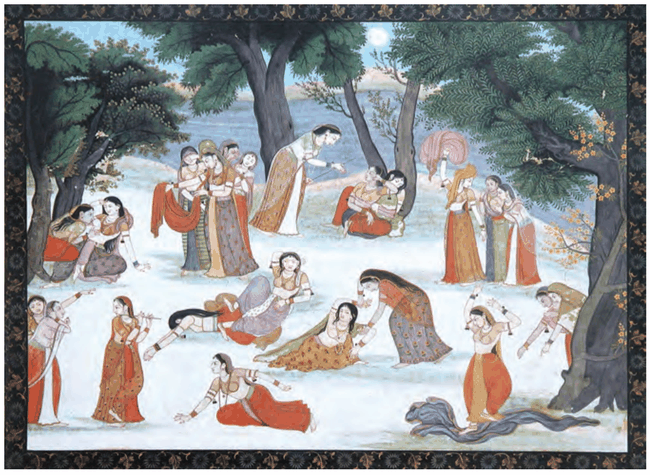
Observe the painting and read the passage given below.
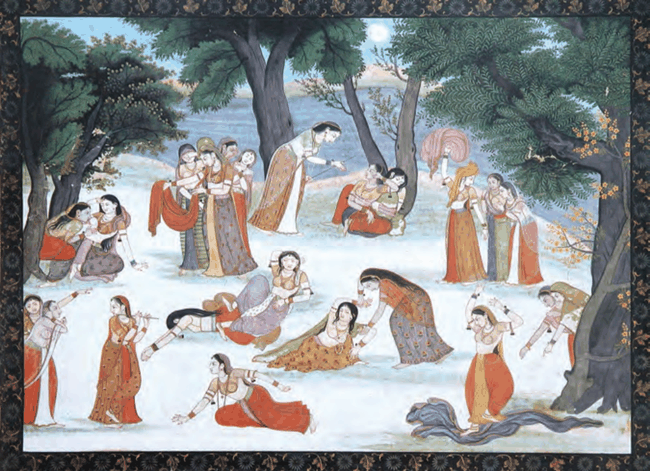
The pain of gopis is real when Krishna suddenly disappears. With minds engrossed in thoughts of Krishna, the gopis recall and enact his various lilas or feats. Some of them being — the killing of Putana, liberation of Yamala–Arjun after Krishna was tied to a mortar by Yashoda, lifting of Mount Govardhan and rescuing the inhabitants of Braj from the heavy downpour and wrath of Indra, subduing of serpent Kaliya, and the intoxicating call and allure of Krishna’s flute. The gopis take on different roles and emulate his divine sports.
How does the gopi in the extreme bottom left enact Krishna’s part in the painting?
Answer & explanation
Correct answer: option 2
The correct answer is Option (2) → By playing the flute
Option (1) By lifting Mount Govardhan — Incorrect. This is the gopi sporting a turban in another group; she lifts her piled-up odhni as the mountain.
Option (2) By playing the flute — Correct. At the extreme left in the bottom, a gopi takes Krishna’s part as he plays the flute.
Option (3) By sucking the bosom of another gopi — Incorrect. This is the gopi on the extreme left, who enacts Krishna killing Putana.
Option (4) By dancing and singing — Incorrect. Some gopis dance and sing around the flute player, but they do not act as Krishna.
NCERT (2026-27): “Re-enacting Krishna’s deeds The artist captures and evokes these sensitive images exquisitely in this folio. On the extreme left, a gopi enacts Krishna’s part as she bends forward and appears to suck the bosom of another gopi, who plays the role of Putana … In the adjoining group, a gopi, sporting a turban, lifts her piled up odhni atop in the guise of lifting Mount Govardhan, while others seek protection underneath. To the extreme left in the bottom, a gopi enacts Krishna, who is playing flute, as some gopis dance and sing, and others crawl towards him, disentangling themselves from their angry mothers-in-law, who try to drag and hold them back from going.”
“Re-enacting Krishna’s deeds, Bhagvata Purana, Guler–Kangra, India, 1780–85, Private Collection” |