
The element that can exhibit the highest number of oxidation states among the following is:
Answer & explanation
Correct answer: option 1
The correct answer is Option (1) → Mn
A transition metal can use its 4s electrons and then some of its 3d electrons in bonding. Up to manganese, the highest stable oxidation state equals the sum of the 4s and 3d electrons; after manganese the d subshell holds more than five electrons, and the higher states become unstable.
Configuration: Manganese (Z = 25) is [Ar]3d54s2.
Electrons available: it has 2 + 5 = 7 electrons in the 4s and 3d orbitals, and it can use any number of them from 2 to 7.
So it shows every state from +2 (as in \( \ce{Mn^2+} \)) to +7 (as in \( \ce{MnO4^-} \)): six oxidation states, the most in the first transition series.
Why the other options are incorrect
Option (2) Co — Incorrect.
Configuration: Cobalt (Z = 27) is [Ar]3d74s2.
Result: with seven d electrons it lies past the middle of the series, so its higher states are unstable; it shows only +2, +3 and +4, of which +2 and +3 are common.
Option (3) V — Incorrect.
Configuration: Vanadium (Z = 23) is [Ar]3d34s2.
Result: it has only 2 + 3 = 5 electrons to lose or share, so its highest state is +5, and it shows four states, +2 to +5.
Option (4) Ni — Incorrect.
Configuration: Nickel (Z = 28) is [Ar]3d84s2.
Result: its third ionisation enthalpy is high, so states above +2 are hard to reach; it shows +2, +3 and +4, and +2 is the common one.
NCERT (2026-27 edition):
Oxidation States
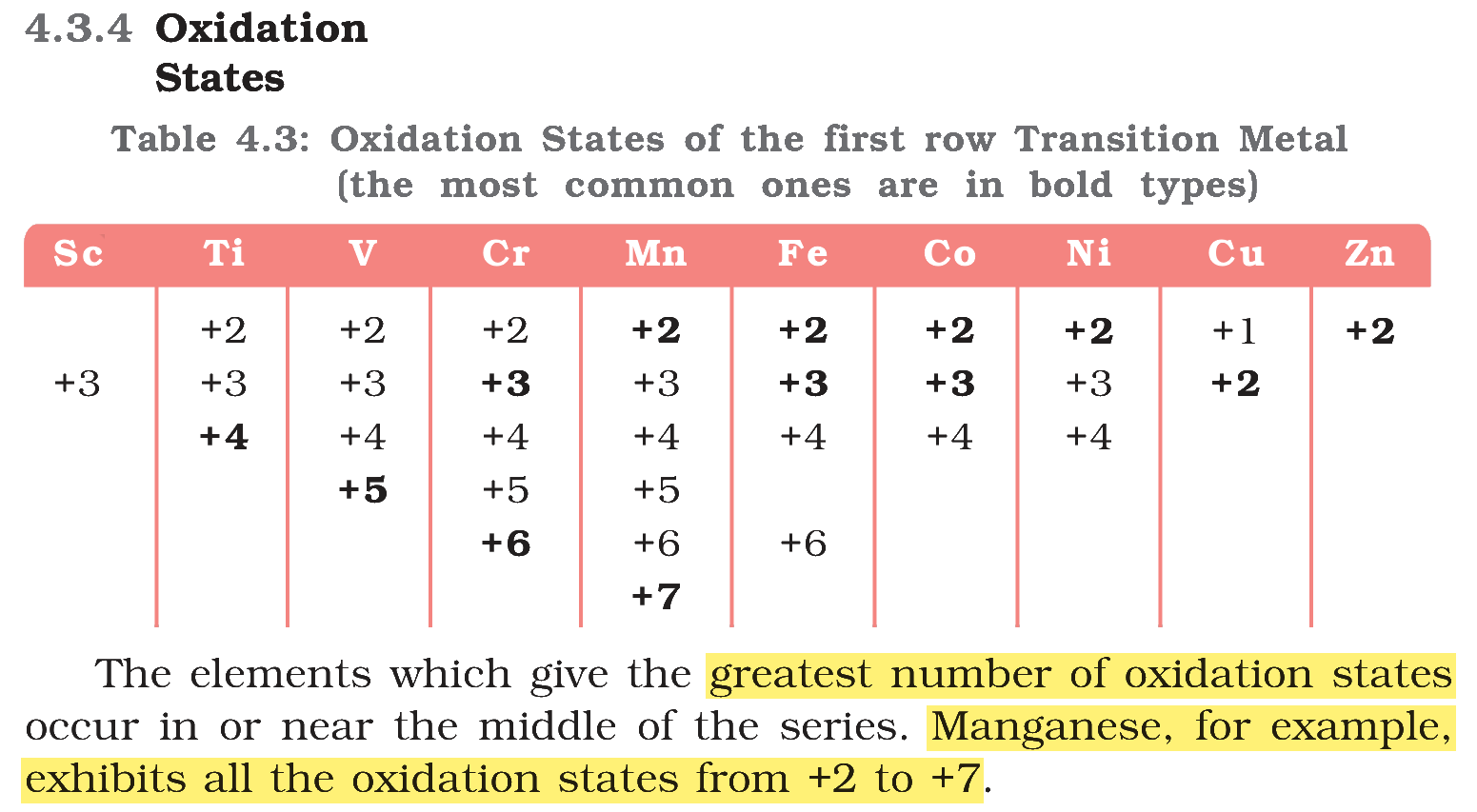
4.3.4 Oxidation States – “… The maximum oxidation states of reasonable stability correspond in value to the sum of the s and d electrons upto manganese (TiIVO2, VVO2+, CrVIO42–, MnVIIO4–) followed by a rather abrupt decrease in stability of higher oxidation states, so that the typical species to follow are FeII,III, CoII,III, NiII, CuI,II, ZnII.”