Which of the following amine will not undergo acylation reaction?
Answer & explanation
Correct answer: option 3
The correct answer is Option (3) → N,N-Diethyl aniline
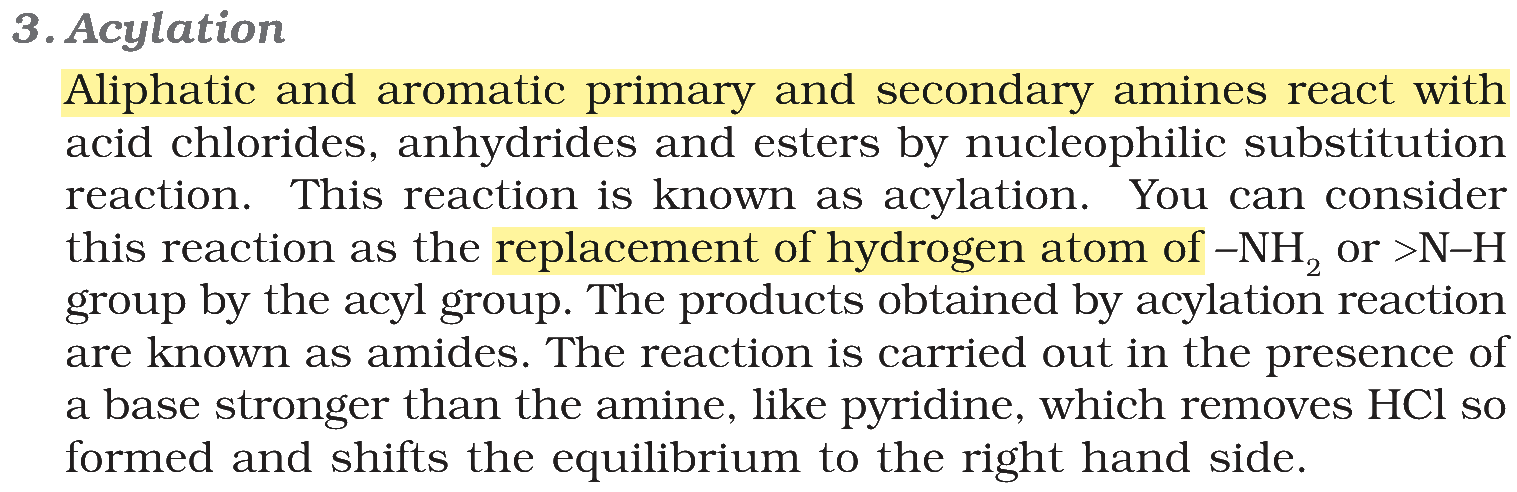
Acylation of an amine replaces a hydrogen atom on nitrogen by an acyl group (\( \ce{RCO-} \)). The amine must therefore have at least one N–H bond: primary and secondary amines are acylated, but tertiary amines are not.
\( \displaystyle \ce{C2H5NH2 + CH3COCl} \xrightarrow{\text{pyridine}} \ce{C2H5NHCOCH3 + HCl} \)
Option (1) Methylamine — Undergoes acylation (primary amine). \( \ce{CH3NH2} \) has two N–H hydrogens; it gives N-methylethanamide with ethanoyl chloride.
Option (2) Ethylamine — Undergoes acylation (primary amine). \( \ce{C2H5NH2} \) gives N-ethylethanamide, as in the equation above.
Option (3) N,N-Diethyl aniline — Does not undergo acylation (tertiary amine). In \( \ce{C6H5N(C2H5)2} \) the nitrogen carries a phenyl group and two ethyl groups and no hydrogen, so there is nothing for the acyl group to replace.
Option (4) N-Methylmethanamine — Undergoes acylation (secondary amine). \( \ce{(CH3)2NH} \) has one N–H hydrogen; it gives N,N-dimethylethanamide.
NCERT (2026-27 edition):
Acylation