
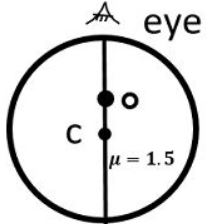
There is a small air bubble inside a glass sphere (μ = 1.5) of radius 10 cm. The bubble is 4.0 cm below the surface and is viewed normally from outside as shown. The apparent depth of the bubble will be
Answer & explanation
Correct answer: option 3
The correct answer is Option (3) → 3.0 cm below the surface
Given a glass sphere with refractive index $ \mu = 1.5 $ and radius $R = 10\ \text{cm}$. The bubble lies $4.0\ \text{cm}$ below the inner surface, i.e. at object distance $u = 4\ \text{cm}$ measured from the surface along the normal.
Use the spherical refraction formula (Cartesian sign convention):
$\displaystyle \mu\!\left(\frac{1}{u}\right) + 1\!\left(\frac{1}{v}\right) = \frac{1- \mu}{R}$
Here the center of curvature is inside the glass (opposite the refracted side), so $R = -10\ \text{cm}$. Substitute $ \mu = 1.5 $, $u = 4 $, $R=-10 $:
$1.5\!\left(\frac{1}{4}\right) + \frac{1}{v} = \frac{1-1.5}{-10}$
$\frac{1}{v} = \frac{1-1.5}{-10} - \frac{1.5}{4} = 0.05 - 0.375 = -0.325$
$\Rightarrow v = -\frac{1}{0.325} \approx -3.08\ \text{cm}.$
The negative sign shows the image is virtual and lies inside the glass on the same side as the bubble, at a distance $|v|\approx 3.08\ \text{cm}$ below the surface.
Therefore the apparent depth of the bubble (as seen from outside) is approximately $3.08\ \text{cm}\approx 3.0\ \text{cm}$ below the surface.