
CUETMOCK
  • Pricing
  • Mentors
Log inStart freeStart free mocks→

First test, then trust

Try a free CUET mock test.

Join 5,00,000+ students who rehearsed exam day on the exact NTA screen before sitting CUET. On the web and on Android.

Start free mocks →Get the Android app
CUETMOCK

India's #1 CUET Mock Test Platform. Original NCERT-based questions on the exact NTA exam screen — trusted by 5,00,000+ students since CUET 2022.

Get it onGoogle PlayScan to download the CUETMOCK app

Mock tests

  • CUET mock test series
  • Browse all papers
  • Commerce mocks
  • Humanities (Arts) mocks
  • Science mocks
  • Languages & GAT mocks
  • Free practice questions
  • Pricing

Resources

  • CUET exam guide
  • CUET syllabus
  • Universities accepting CUET
  • Expert blogs
  • News & notifications
  • Webinars & counselling
  • CUET score calculator
  • How we estimate your rank
  • FAQs

Company

  • About us
  • Our leadership & team
  • Our toppers
  • Mentors
  • For schools
  • Contact us
  • Terms
  • Privacy
  • Refund policy

Talk to us

+91 7696 6630 56info@cuetmock.comWhatsApp us

Our other platforms

  • JEE Mock — For IIT-JEE aspirants
  • NEET Mock — For NEET aspirants

Newsletter

Exam updates, study material and offers — no spam.

© 2026 NYC Ventures Pvt. Ltd.

701-702, Royal Business Park, Zirakpur, Punjab - 140603

  • Terms of use
  • Privacy policy
  • Refund policy
  • Contact us

iCUETMOCK is an independent preparation platform, not affiliated with the National Testing Agency (NTA). Always check exam details on the official NTA website.

  • Home
  • Mock tests
  • CUET guide
  • Pricing
  • Log in
Home/Practice questions/Chemistry
ChemistryOrganic: Amines

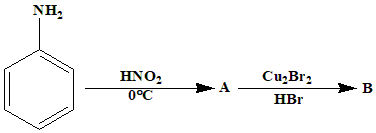
The compound B is:

Figure for Q21

The compound \(B\) is:

Answer & explanation+

Correct answer: option 3

The correct answer is Option (3) → Bromobenzene

Aniline reacts with nitrous acid (\( \ce{NaNO2} \) + HCl) at 273–278 K to give benzenediazonium chloride; this is A. This diazotisation is carried out cold because the diazonium salt decomposes on warming.

    \( \ce{C6H5NH2 + NaNO2 + 2HCl} \xrightarrow{\text{273-278 K}} \ce{C6H5N2+Cl- + NaCl + 2H2O} \)

With \( \ce{Cu2Br2} \)/HBr the –\( \ce{N2^{+}} \) group is replaced by bromine and nitrogen gas is given off (Sandmeyer reaction). B is bromobenzene:

    \( \ce{C6H5N2+Cl-} \xrightarrow{\ce{Cu2Br2/HBr}} \ce{C6H5Br + N2} \)

The diazonium group is a very good leaving group, so the same salt gives many products, each with its own reagent:

  • Sandmeyer reaction (Cu(I) salts): \( \ce{C6H5N2+Cl-} \xrightarrow{\ce{Cu2Cl2/HCl}} \ce{C6H5Cl + N2} \); with \( \ce{CuCN/KCN} \) it gives \( \ce{C6H5CN} \).

  • Gattermann reaction (copper powder and the halogen acid): \( \ce{C6H5N2+Cl-} \xrightarrow{\ce{Cu/HBr}} \ce{C6H5Br + N2 + CuCl} \)

  • Iodide ion: \( \ce{C6H5N2+Cl- + KI -> C6H5I + KCl + N2} \)

  • Water, warm (above 283 K): \( \ce{C6H5N2+Cl- + H2O -> C6H5OH + N2 + HCl} \)

Why the other options are incorrect

  • Option (1) Benzene — Incorrect. Benzene forms when the diazonium salt is reduced by a mild reducing agent such as hypophosphorous acid (or ethanol), not with \( \ce{Cu2Br2} \)/HBr:

        \( \ce{C6H5N2+Cl- + H3PO2 + H2O -> C6H6 + N2 + H3PO3 + HCl} \)

  • Option (2) Nitrobenzene — Incorrect. The –\( \ce{NO2} \) group is introduced by heating the diazonium fluoroborate with aqueous \( \ce{NaNO2} \) in the presence of copper; no nitrite is present here:

        \( \ce{C6H5N2+Cl- + HBF4 -> C6H5N2+BF4- + HCl} \)

        \( \ce{C6H5N2+BF4-} \xrightarrow[\text{Cu, }\Delta]{\ce{NaNO2(aq)}} \ce{C6H5NO2 + NaBF4 + N2} \)

  • Option (4) Phenylcopper (C6H5–Cu) — Incorrect. Cu(I) only helps the replacement of the –\( \ce{N2^{+}} \) group by the halide ion; copper does not become bonded to the ring in the product.

NCERT (2026-27 edition):
Reactions Involving Displacement of Nitrogen – “Diazonium group being a very good leaving group, is substituted by other groups such as Cl–, Br–, I–, CN– and OH– which displace nitrogen from the aromatic ring. The nitrogen formed escapes from the reaction mixture as a gas.
1. Replacement by halide or cyanide ion: The Cl–, Br– and CN– nucleophiles can easily be introduced in the benzene ring in the presence of Cu(I) ion. This reaction is called Sandmeyer reaction.”

Advertisement

Practise more on Organic: Amines

Chapter-wise mocks on the real NTA exam screen, with solutions and your rank. Your first mocks are free.

Start free mocks →

Advertisement

Next questions

  1. Which of the following are arguments against social responsibility? A) Violation of profit maximisation objectiveB) Converting problems int…Business Studies · Social Responsibilities of Business and Business Ethics
  2. The passage suggests that the growth in print media and industrialization provided a situation in which everyone reads the same news. This…Sociology · Social Change and Development in India: Mass Media and Communication
  3. "देवनागरी लिपि" का सम्बन्ध किस भाषा से है?Hindi · व्याकरण - सभाषा
  4. Old partnership firm will dissolve in which of the following cases?Accountancy Part A · Admission of a Partner
  5. The shortest distance between the lines 2x + y + z - 1= 0, 3x + y + 2z - 2=0 and x = y = z, isSection B1 · Three-dimensional Geometry
  6. Identify the cell that is amoeboid in shape.General Aptitude Test · General Knowledge
  7. What is the derivative of y=√(e^sqrt x)?Maths. Section B1 · Continuity and Differentiability
  8. From the following compute price index by using simple average of price relatives: Commodities and unit Price in 2009 (₹) Price in 2010 (₹)…Applied Maths. Section B2 · Index Numbers and Time Based Data
  9. World Economic Forum (WEF) Annual meeting 2023 was held in _____.General Aptitude Test · Current Affairs
  10. Rearrange the following phrases in the correct sequence to form a meaningful sentence:(A) no one in the village would think of harming them…English · Arrange in Meaningful Sequence