
CUETMOCK
  • Pricing
  • Mentors
Log inStart freeStart free mocks→

First test, then trust

Try a free CUET mock test.

Join 5,00,000+ students who rehearsed exam day on the exact NTA screen before sitting CUET. On the web and on Android.

Start free mocks →Get the Android app
CUETMOCK

India's #1 CUET Mock Test Platform. Original NCERT-based questions on the exact NTA exam screen — trusted by 5,00,000+ students since CUET 2022.

Get it onGoogle PlayScan to download the CUETMOCK app

Mock tests

  • CUET mock test series
  • Commerce mocks
  • Humanities (Arts) mocks
  • Science mocks
  • Languages & GAT mocks
  • Free practice questions
  • Pricing

Resources

  • CUET exam guide
  • CUET syllabus
  • Universities accepting CUET
  • Expert blogs
  • News & notifications
  • Webinars & counselling
  • CUET score calculator
  • How we estimate your rank
  • FAQs

Company

  • About us
  • Our leadership & team
  • Our toppers
  • Mentors
  • For schools
  • Contact us
  • Terms
  • Privacy
  • Refund policy

Talk to us

+91 7696 6630 56info@cuetmock.comWhatsApp us

Our other platforms

  • JEE Mock — For IIT-JEE aspirants
  • NEET Mock — For NEET aspirants

Newsletter

Exam updates, study material and offers — no spam.

© 2026 NYC Ventures Pvt. Ltd.

701-702, Royal Business Park, Zirakpur, Punjab - 140603

  • Terms of use
  • Privacy policy
  • Refund policy
  • Contact us

iCUETMOCK is an independent preparation platform, not affiliated with the National Testing Agency (NTA). Always check exam details on the official NTA website.

  • Home
  • Mock tests
  • CUET guide
  • Pricing
  • Log in
Home/Practice questions/Chemistry
ChemistryInorganic: D and F Block Elements

Which of the following compounds is both paramagnetic and coloured?

Which of the following compounds is both paramagnetic and coloured?

Answer & explanation+

Correct answer: option 2

The correct answer is Option (2) → VOSO4

A compound is paramagnetic only if its metal ion has unpaired electrons, and a d–d colour needs a partly filled d subshell. A d0 or d10 ion has neither.

  • \( \ce{(NH4)2[TiCl6]} \): 2(+1) + x + 6(−1) = 0, so Ti is +4; Ti (Z = 22) is [Ar]3d24s2, so \( \ce{Ti^4+} \) is 3d0: no unpaired electron, so it is diamagnetic.

  • \( \ce{VOSO4} \): the ions are \( \ce{VO^2+} \) and \( \ce{SO4^2-} \); x + (−2) = +2, so V is +4; V (Z = 23) is [Ar]3d34s2, so \( \ce{V^4+} \) is 3d1: one unpaired electron, so it is paramagnetic, and the d electron gives a blue colour.

  • \( \ce{K2Cr2O7} \): 2(+1) + 2x + 7(−2) = 0, so Cr is +6; Cr (Z = 24) is [Ar]3d54s1, so \( \ce{Cr^6+} \) is 3d0: the orange crystals are coloured but have no unpaired electron, so they are diamagnetic.

  • \( \ce{K3[Cu(CN)4]} \): 3(+1) + x + 4(−1) = 0, so Cu is +1; Cu (Z = 29) is [Ar]3d104s1, so \( \ce{Cu^+} \) is 3d10: all electrons paired, diamagnetic and colourless.

Only VOSO4 is both paramagnetic and coloured.

NCERT (2026-27 edition):
4.3.9 Magnetic Properties – “Paramagnetism arises from the presence of unpaired electrons, each such electron having a magnetic moment associated with its spin angular momentum and orbital angular momentum.”

4.3.10 Formation of Coloured Ions – “When an electron from a lower energy d orbital is excited to a higher energy d orbital, the energy of excitation corresponds to the frequency of light absorbed (Unit 5). This frequency generally lies in the visible region. … In aqueous solutions where water molecules are the ligands, the colours of the ions observed are listed in Table 4.8.”

Table 4.8: Colours of Some of the First Row (aquated) Transition Metal Ions
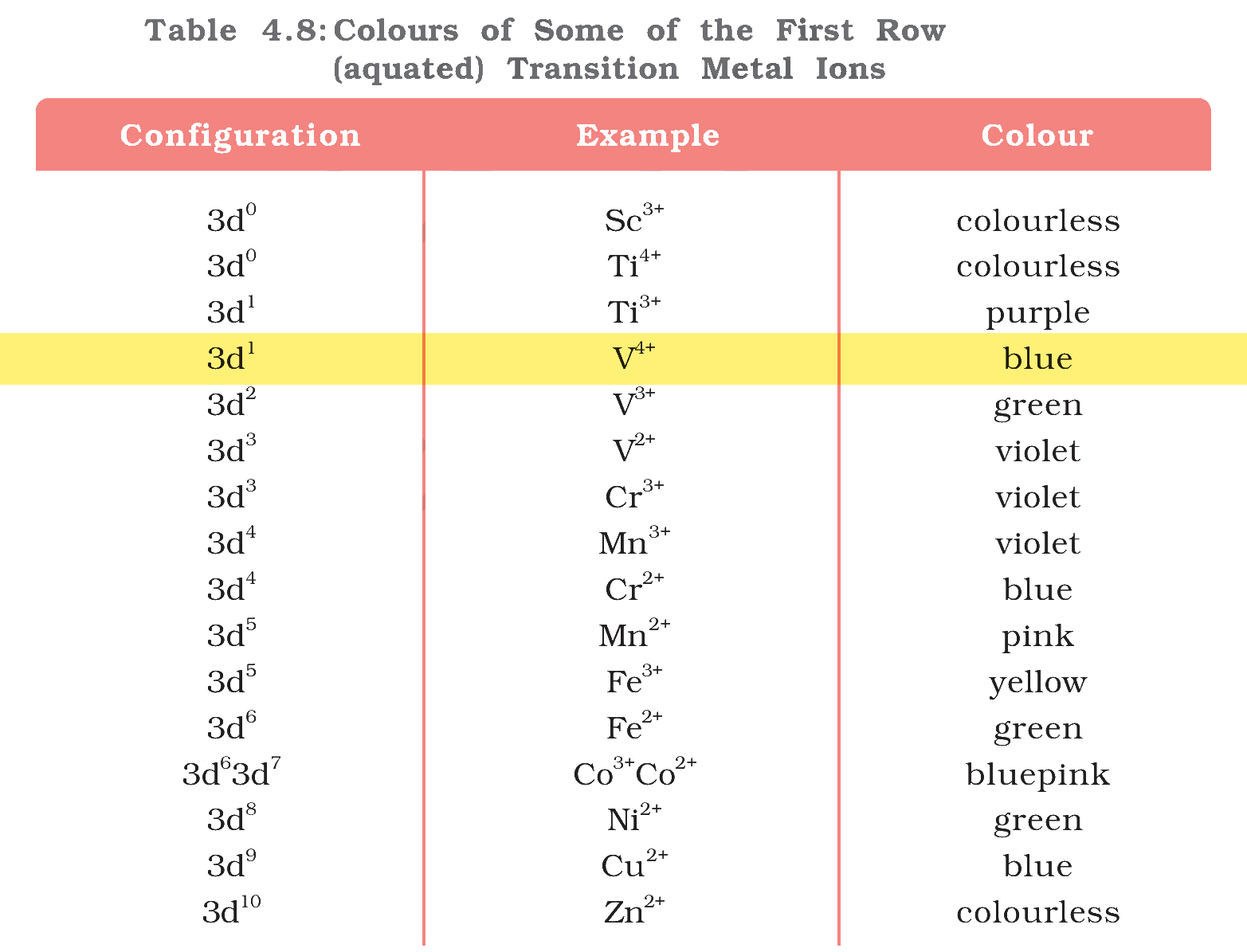
Table 4.8

Advertisement

Practise more on Inorganic: D and F Block Elements

Chapter-wise mocks on the real NTA exam screen, with solutions and your rank. Your first mocks are free.

Start free mocks →

Advertisement

Next questions

  1. What is the formula of Siderite?Chemistry · Inorganic: General Principles and Processes of Isolation of Elements
  2. From which word do these scholars derive the term?History · Medieval India: Bhakti Sufi Traditions
  3. How does a semiconductor behave at absolute zero?Physics · Semiconductors and Electronic Devices
  4. Select the option in which the given figure is embedded (rotation is NOT allowed)General Aptitude Test · Verbal Reasoning
  5. A thin circular ring of mass M and radius R is rotating in a horizontal plane about an axis vertical to its plane with a constant angular v…Physics · System of Particle and Rotational Motion
  6. हिमालय को किसका उपहार मिल रहा है?Hindi · Comprehension - (Poetry / Literary)
  7. The straight line (x + 3)/3 = (y + 2)/4 = (z + 1)/0 isMaths. Section B1 · Three-dimensional Geometry
  8. In March 1946 the British Cabinet sent a three member mission to Delhi to examine the League's demand and to suggest a suitable political f…History · Modern India: Understanding Partition
  9. Who among the following was the founder of the Kirana Gharana of classical music?General Aptitude Test · General Knowledge
  10. 'ज्येष्ठ' का तद्भव रूप है -Hindi · शब्द भेद (तत्सम, तद्भव, देशज, विदेशज)