
Read the following passage and answer the questions.
The figure shows the set-up a student uses to study the photoelectric effect. An evacuated glass tube holds a photosensitive plate C (the emitter) and a metal plate A (the collector). Light from a source S enters through a quartz window and falls on plate C. A battery keeps a potential difference between C and A, and she can change its value. A commutator reverses the polarity, so plate A can be made positive or negative with respect to C. A voltmeter reads this potential difference, and a microammeter reads the photocurrent.
She chooses the frequency of the light by placing coloured filters in its path. She changes the intensity by moving the source nearer to or farther from plate C. For each setting, she records the microammeter reading as the potential of A is changed from a large positive value to negative values.
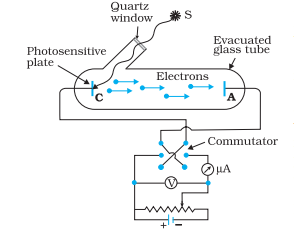
The filter and the position of the source are kept fixed. Plate A is now made more and more negative with respect to plate C. How does the microammeter reading change?
Answer & explanation
Correct answer: option 4
The correct answer is Option (4) → It decreases and becomes zero at a sharply defined negative potential.
When plate A is negative with respect to C, it repels the photoelectrons. Only the electrons with enough kinetic energy can still reach A.
Option (1) It falls to zero as soon as A is made negative. — Incorrect. The electrons leave C with some kinetic energy. The faster ones still reach A against a small negative potential, so the current does not stop at once.
Option (2) It stays constant up to a certain negative potential and then drops to zero suddenly. — Incorrect. The photoelectrons come out with different kinetic energies. Each step to a more negative potential turns back some more of the slower electrons, so the reading falls steadily.
Option (3) It rises to a saturation value. — Incorrect. The current rises to a saturation value when A is made more positive. A negative potential on A pushes electrons back, so the reading cannot rise on this side.
Option (4) It decreases and becomes zero at a sharply defined negative potential. — Correct. Fewer electrons reach A as the potential becomes more negative. The current becomes zero when even the most energetic electrons are turned back. This value is the stopping potential \( V_0 \).
NCERT (2026-27):
Effect of potential on photoelectric current – “… The photocurrent is found to decrease rapidly until it drops to zero at a certain sharply defined, critical value of the negative potential V0 on the plate A. …”