
Observe the given figure representing different are pyramids for human population answer the following question.
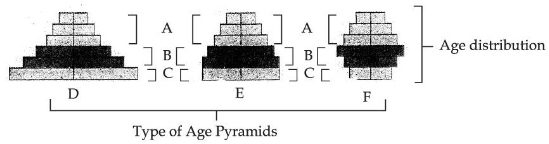
Match List - I with List - II.
|
List – I |
List – II |
|
(A) Stable |
(I) A |
|
(B) Post reproductive stage |
(II) F |
|
(C) Declining |
(III) D |
|
(D) Expanding |
(IV) E |
Choose the correct answer from the options given below:
Answer & explanation
Correct answer: option 3
The correct answer is Option (3) → (A)-(IV), (B)-(I), (C)-(II), (D)-(III)
|
List – I |
List – II |
|
(A) Stable |
(IV) E |
|
(B) Post reproductive stage |
(I) A |
|
(C) Declining |
(II) F |
|
(D) Expanding |
(III) D |
The shapes of age pyramids can be classified as follows:
- Triangular-shaped age pyramids indicate a high number of pre-reproductive individuals, a moderate number of reproductive individuals, and even fewer post-reproductive individuals. This type of population is anticipated to grow or expand.
- Bell-shaped age pyramids occur when pre-reproductive and reproductive individuals are nearly equal in numbers or percentages, with relatively fewer post-reproductive individuals. This population is expected to remain stable.
- Urn-shaped age pyramids exhibit low numbers or percentages of pre-reproductive individuals, a maximum number of individuals in the reproductive age group, and a small number of individuals in the post-reproductive age group. Such a population is considered to decline.

Representation of age pyramids for human population