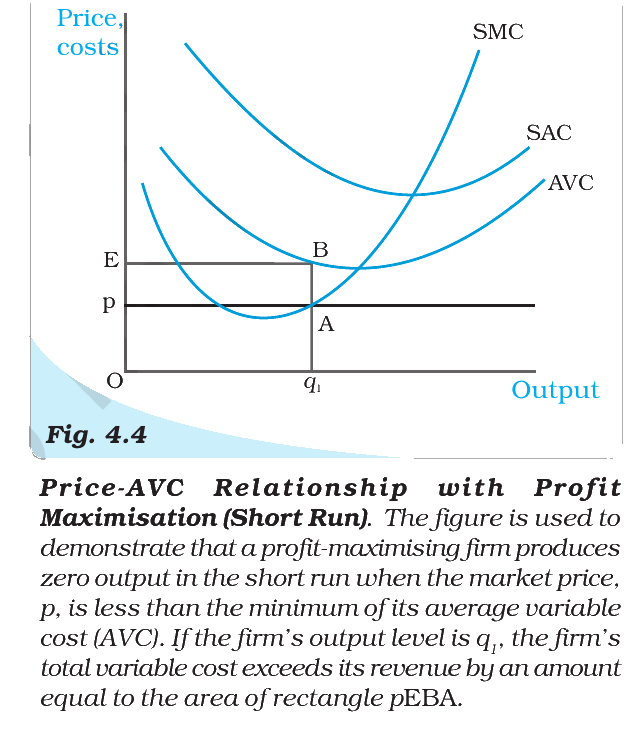
Study the diagram given below and answer the question.
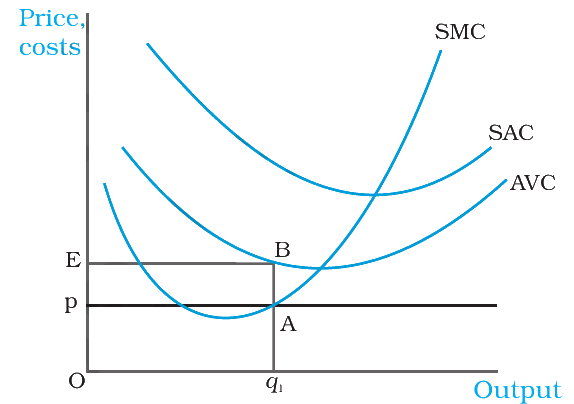
What is the profit of the firm at the output level q1?
Answer & explanation
Correct answer: option 2
The correct answer is Option (2) → – [Area of rectangle pEBA] – TFC
Profit = TR − (TVC + TFC). At q1, the price p is below AVC, so TVC is larger than TR. The amount by which TVC exceeds TR is the area of rectangle pEBA. So profit is minus pEBA, minus TFC.
Option (1) – [Area of rectangle pEBA] — Incorrect. This counts only the loss on variable cost. In the short run the firm must also pay its fixed cost, so TFC is subtracted too.
Option (2) – [Area of rectangle pEBA] – TFC — Correct. The firm loses pEBA on its variable cost and also bears the whole fixed cost.
Option (3) – [Area of rectangle pEBA] + TFC — Incorrect. TFC is a cost, so it is subtracted.
Option (4) – TFC — Incorrect. This is the profit at zero output. At q1 the firm also loses pEBA, so its profit is lower than – TFC.
Note: The NCERT book (2026-27) prints the firm’s profit at q1 as ‘[(area EBAp)-TFC]’. A minus sign before the area is missing there: the same sentence says this profit is less than what the firm gets by not producing (– TFC). The correct profit is – [area pEBA] – TFC.
NCERT (2026-27): “Case 1: Price must be greater than or equal to AVC in the short run … Notice that the firm’s total revenue at q1 is as follows
|