
CUETMOCK
  • Pricing
  • Mentors
Log inStart freeStart free mocks→

First test, then trust

Try a free CUET mock test.

Join 5,00,000+ students who rehearsed exam day on the exact NTA screen before sitting CUET. On the web and on Android.

Start free mocks →Get the Android app
CUETMOCK

India's #1 CUET Mock Test Platform. Original NCERT-based questions on the exact NTA exam screen — trusted by 5,00,000+ students since CUET 2022.

Get it onGoogle PlayScan to download the CUETMOCK app

Mock tests

  • CUET mock test series
  • Browse all papers
  • Commerce mocks
  • Humanities (Arts) mocks
  • Science mocks
  • Languages & GAT mocks
  • Free practice questions
  • Pricing

Resources

  • CUET exam guide
  • CUET syllabus
  • Universities accepting CUET
  • Expert blogs
  • News & notifications
  • Webinars & counselling
  • CUET score calculator
  • How we estimate your rank
  • FAQs

Company

  • About us
  • Our leadership & team
  • Our toppers
  • Mentors
  • For schools
  • Contact us
  • Terms
  • Privacy
  • Refund policy

Talk to us

+91 7696 6630 56info@cuetmock.comWhatsApp us

Our other platforms

  • JEE Mock — For IIT-JEE aspirants
  • NEET Mock — For NEET aspirants

Newsletter

Exam updates, study material and offers — no spam.

© 2026 NYC Ventures Pvt. Ltd.

701-702, Royal Business Park, Zirakpur, Punjab - 140603

  • Terms of use
  • Privacy policy
  • Refund policy
  • Contact us

iCUETMOCK is an independent preparation platform, not affiliated with the National Testing Agency (NTA). Always check exam details on the official NTA website.

  • Home
  • Mock tests
  • CUET guide
  • Pricing
  • Log in
Home/Practice questions/Physics
PhysicsElectric Charges and Fields

Which of the following option is correct by using Coulomb's law.

Which of the following option is correct by using Coulomb's law.

Answer & explanation+

Correct answer: option 4

The correct answer is Option (4)

Figure for option 4

(if the product of \( q_1q_2 \) is negative)

By Coulomb's law the forces between two point charges act along the line joining them, and the force on \( q_1 \) due to \( q_2 \) is equal and opposite to the force on \( q_2 \) due to \( q_1 \).

    \( \displaystyle \vec{F}_{12} = -\vec{F}_{21} \)

If \( q_1q_2 \gt 0 \) (like charges) the forces are repulsive: each force points away from the other charge. If \( q_1q_2 \lt 0 \) (unlike charges) they are attractive: each force points towards the other charge.

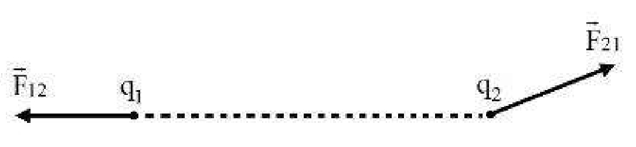
In Option (4) the product is negative, \( \vec{F}_{12} \) on \( q_1 \) points towards \( q_2 \), and \( \vec{F}_{21} \) on \( q_2 \) points towards \( q_1 \). The two forces lie along the line joining the charges and are equal and opposite, which is the correct picture of attraction.

Why the other options are incorrect
  • Figure for option 1

    (if the product of \( q_1q_2 \) is positive)

    Option (1) — Incorrect. For a positive product the force on \( q_1 \) correctly points away from \( q_2 \), but \( \vec{F}_{21} \) is drawn at an angle to the line joining the charges. Coulomb forces act only along that line.

  • Figure for option 2

    (if the product of \( q_1q_2 \) is negative)

    Option (2) — Incorrect. For a negative product both forces should point towards the other charge. Here \( \vec{F}_{21} \) points away from \( q_1 \), and the two forces point the same way instead of being opposite.

  • Figure for option 3

    (if the product of \( q_1q_2 \) is positive)

    Option (3) — Incorrect. For a positive product both forces should point away from each other. Here \( \vec{F}_{21} \) points towards \( q_1 \), and the two forces point the same way instead of being opposite.

NCERT (2026-27):
Coulomb’s Law – “… Equation (1.3) is valid for any sign of q1 and q2 whether positive or negative. If q1 and q2 are of the same sign (either both positive or both negative), \( \mathbf{F}_{21} \) is along \( \hat{\mathbf{r}}_{21} \), which denotes repulsion, as it should be for like charges. If q1 and q2 are of opposite signs, \( \mathbf{F}_{21} \) is along \( -\hat{\mathbf{r}}_{21} \) (\( = \hat{\mathbf{r}}_{12} \)), which denotes attraction, as expected for unlike charges.”


Coulomb’s Law – “… The force \( \mathbf{F}_{12} \) on charge q1 due to charge q2, is obtained from Eq. (1.3), by simply interchanging 1 and 2, i.e.,

    \( \displaystyle \mathbf{F}_{12} = -\mathbf{F}_{21} \)

Thus, Coulomb’s law agrees with the Newton’s third law.”

Advertisement

Practise more on Electric Charges and Fields

Chapter-wise mocks on the real NTA exam screen, with solutions and your rank. Your first mocks are free.

Start free mocks →

Advertisement

Next questions

  1. Before launching its new juicer, Mixo Ltd. decides what it wants to achieve through the amount it charges, such as a larger market share. I…Business Studies · Marketing
  2. To which deity did Manikkavachakar devote his compositions in Tamil?History · Medieval India: Bhakti Sufi Traditions
  3. If cos^-1α + cos^-1β + cos^-1γ = 3π , then α(β+γ) + β(γ+α) + γ(α+β) equals:Maths. Section B1 · Inverse Trigonometric Functions
  4. In the nineteenth century, in India, why do the male workers migrate to the cities alone and not with their families?History · Modern India: Colonial cities
  5. Spot the error in the following sentence. A. Block of Residential apartments B. are coming up C. near our house. D. No errorEnglish · Spot Error
  6. What happens when acetic acid reacts with PCl3?Chemistry · Organic: Aldehydes, Ketones and Carboxylic Acids
  7. सूची I का सूची II से मिलान कीजिए सूची I सूची II A. जनप्रिय I. द्विगु समास B. पंचामृत II. अव्ययी भाव C. यथाशक्ति III. तत्पुरुष समास D. दशानन…Hindi · व्याकरण - ससमास
  8. Which of the following painted manuscripts are considered under Western Indian School of Painting? A. Astasahasrika Prajnaparamita B. Nimat…Fine Arts · The Manuscript Painting Tradition
  9. The electric potential V at any point (x, y, z) in space is given by V=6x V , where x is in metres. The electric field at the point (1 m, 0…Physics · Electrostatic Potential and Capacitance
  10. Select the Venn Diagram, the best represents the relationships between the following words. Uncle, Aunt, MotherGeneral Aptitude Test · Verbal Reasoning