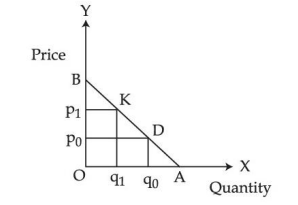
In the Linear Demand Curve AB, the elasticity of demand \( (e_D) \) at point D can be measured geometrically by the formula _ _ _ _ _ _ _ _.
Answer & explanation
Correct answer: option 1
The correct answer is Option (1) → \( e_D=\displaystyle\frac{DA}{DB} \)
On a straight-line demand curve, the elasticity at any point is the lower segment divided by the upper segment at that point.
Here the curve runs from B on the price axis to A on the quantity axis. At point D, the lower segment is DA and the upper segment is DB.
Option (1) \( e_D=\displaystyle\frac{DA}{DB} \) — Correct. Lower segment over upper segment, both measured from D.
Option (2) \( e_D=\displaystyle\frac{DB}{DA} \) — Incorrect. This is the formula turned upside down: upper segment over lower segment.
Option (3) \( e_D=\displaystyle\frac{BK}{KA} \) — Incorrect. The segments are measured from K, not from D, and they are also upside down.
Option (4) \( e_D=\displaystyle\frac{KA}{BK} \) — Incorrect. This is lower over upper segment at point K. It gives the elasticity at K, not at D.
NCERT (2026-27): Introductory Microeconomics — Chapter 2: Theory of Consumer Behaviour
|